Showing posts with label evolution. Show all posts

Evolution is a pain in the ass, especially for herpetologists and ornithologists

Thursday, March 3, 2011 at 1:26 AM Bookmark and Share
The reason? Imagine you have a kid, and your neighbor has 2 kids, then you both find out that really, one of their kids is sort of... yours. (-- awkward pause --) That's basically the problem here:


Herpetology is the study of reptiles and amphibians, however unraveling the evolutionary history of these two groups (along with birds) has shown us that birds are actually nested in among reptiles.

Now, to be fair, I think the comic has it wrong: I mean, shouldn't this justify lumping ornithology in a sub-discipline of herpetology?

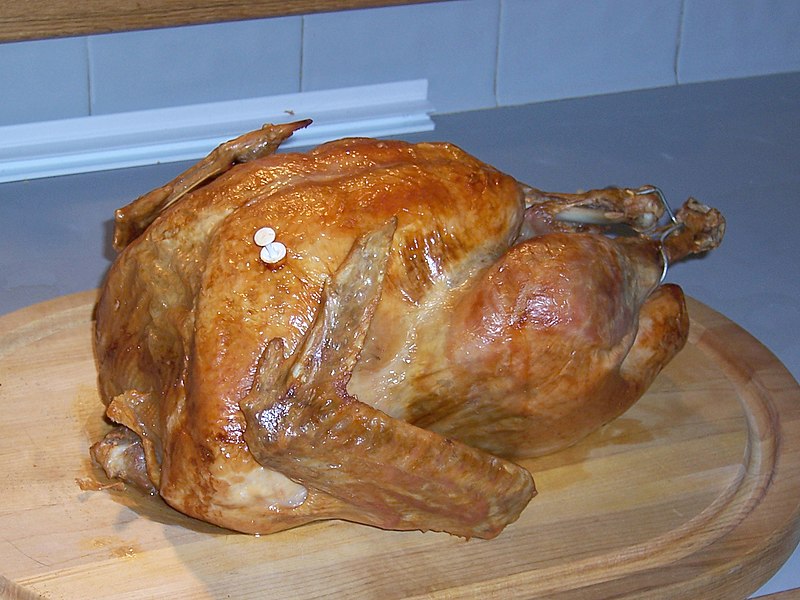
Happy Turkey Day!

Thursday, November 25, 2010 at 9:46 AM Bookmark and Share
There's a Turkey in my fridge waiting to be cooked, but I couldn't resist writing a quick post full of links on today's official bird. Enjoy!

On this blog

External Links


How many species concepts are there?

Thursday, October 21, 2010 at 11:00 AM Bookmark and Share
Do you remember the definition of species from your high school or college biology class?  Me neither -- but worry not!  Even if you remembered it word for word, there's a good chance it's not the same definition your friends and co-workers learned and it's certainly not the only definition floating around out there.  So how many species concepts are there?

According to John S. Wilkins in his recent guest post over at Punctuated Equilibrium (also here on John's blog) there are either 26-27, 7, 2, 1 or 0.  The article is well worth the read as John gives a nice, brief overview of the many different definitions of a biological species, their similarities and differences, and the key concepts behind those definitions. 


If you don't mind my giving away the punchline, here's what it all boils down to:

Final score: 26-27, 7, 2, 1 or 0.

What to think? My solution is this:

There is one species concept (and it refers to real species).

There are two explanations of why real species are species (see my microbial paper, 2007): ecological adaptation and reproductive reach.

There are seven distinct definitions of "species", and 27 variations and mixtures.

And there are n+1 definitions of "species" in a room of n biologists.
For a more detailed treatment of the idea of biological species, see John's book 'Species: A History of the Idea'.

[Hat tip to John Hawks and GrrlScientist]

The Sound of Science: Simon & Garfunkel (feat. Darwin)

Friday, October 1, 2010 at 10:35 AM Bookmark and Share


[via WEIT]

Intelligent Design: Creationism's Trojan Horse

Monday, September 20, 2010 at 4:51 PM Bookmark and Share
A nice look at the history of the ID movement in the talk below, by NCSE board member Dr. Barbara Forrest (see below to jump around the video by topic highlights). You can read more about her book "Creationism's Trojan Horse" in this review at Panda's Thumb, or in the links given below.


A few bookmarks for those of you who'd like to jump around or don't have time to watch the whole thing:
  1. Dembski's juvenile attempt to anonymously thumb his nose at Judge Jones and others @ 1:20
  2. Talk begins @ 4:14
  3. Trojan Horse defined/discussed @ 5:30
  4. Intelligent Design as a Trojan Horse @ 6:00
  5. Dover Trial details begin around 7:50 
  6. Who's Who of the Discovery Institute: Center for the Renewal of Science & Culture @ 9:49
  7. Their infamous Wedge Strategy (and Wedge Document) @ 11:45
  8. Trial details begin around 13:30
  9. More from Dembski starting @ 14:00 (followed by more shenanigans from the Disco'Tute)
  10. Expert witnesses on the side of science (plaintiffs) @ 17:50
  11. Summary of lessons learned from the trial are in a nice book (see resource links below) @ 18:28
  12. Plaintiff's attorneys @ 18:43
  13. Expert witnesses on the side of intelligent design creationism (defendants) including those  who backed out @18:55
  14. Dr. Forrest describes her role in the trial @ 20:50 (followed by a nice summary of "ID = christian creationism")
  15. The evolution of the creationist-turned-ID text, Of Pandas and People @ 29:45
  16. The origin of that accidental term, cdesign proponentsists @ 33:00
  17. Cost of the Dover trial (including Dembski's $20K "for not showing up") @ 35:45
  18. 1982 source of "Complex specified information"; 1982 precursor to "Irreducible Complexity" @ 37:30
  19. Behe continues on after the trial, his book, etc. @ 39:00
  20. Key terms/phrases used by ID proponents - things to look out for @ 39:25
  21. The new replacement creationist text? Explore Evolution @ 41:00
  22. Nice book list of additional reading on the Creationism vs. Evolution conflict @ 42:34
  23. Did you know Dembski helped A. Coulter write ID chapters in 'Godless'? @ 44:06
  24. Talk ends @ 44:40, Q&A begins.
See anything else worth noting? Please take note of the time, and leave a comment below.  If it doesn't slip my mind, I'll try and include comments above on what's in the Q&A when I get a chance.

Resources

  1. Scott, E. C., Branch, G. 2006. Not in our classroom: Why Intelligent Design is Wrong for Our Schools.  http://ncse.com/nioc (purchase here).
  2. Trial Documents from Kitzmiller vs. Dover available here on the NCSE website.
  3. Dr. Forrest's Creationism's Trojan Horse website: http://www.creationismstrojanhorse.com/ Both book info and info/resources from the Dover trial.

More on what Fodor and Piattelli-Palmarini Got Wrong

Friday, July 30, 2010 at 12:12 AM Bookmark and Share
Jerry Fodor and Massimo Piattelli-Palmarini have received quite a bit of criticism since the publication of their book What Darwin Got Wrong, which attempts to argue that evolution by natural selection is basically nonsense.  The consensus seems to be that Fodor and Piattelli-Palmarini don't understand modern evolutionary theory, and that they're plainly wrong. However, in case you think they might be onto something you should check out this July 2010 critique of their book, which also takes them to task for getting it wrong.  The review is written by Harvard philosopher Peter Godfrey-Smith. You should of course click over to the review and give it a good read, but I thought I'd comment here on a few highlights.

Peter begins by recalling a young Noam Chomsky's scathing book review of B. F. Skinner's 1957 book Verbal Behavior, which seems to have rightfully blown those ideas right off the map.  He suggests there is a parallel here, to what Fodor and Piattelli-Palmarini seem to have attempted with their book... except this time it's they who have it wrong.
... A young linguist, Noam Chomsky, published a review of Verbal Behaviour... It was perhaps the most devastating book review ever written.

Chomsky argued that Skinner’s theoretical vocabulary could be applied to human linguistic behaviour only in an empty, post hoc way. He also thought that Skinner’s behaviourism had a simple architectural flaw: it held that external factors – especially experiences of reinforcement – were of ‘overwhelming importance’ in the explanation of behaviour. Hardly any role was given to what Chomsky referred to simply as ‘the internal structure of the organism’. It is unusual to do serious damage to a scientific research programme with a set of general arguments – not by citing experimental or mathematical results, but by looking at the basic ideas and revealing a crack in the foundations. Though the impact of the review itself is sometimes exaggerated, this is the effect Chomsky had on the behaviourist study of humans.

Jerry Fodor now hopes to do something similar to Darwinism in biology. Fodor has been making sceptical remarks about Darwinian ideas for decades. Three years ago he wrote a direct attack on Darwinian evolutionary theory in the LRB, and he has now published What Darwin Got Wrong, along with Massimo Piattelli-Palmarini. Fodor and Piattelli-Palmarini believe that they can replicate Chomsky’s demolition job on Skinner because ‘Skinner’s account of learning and Darwin’s account of evolution are identical in all but name.’ As we shall see, ‘identical’ is quite a stretch, but there is a real analogy.
Peter then recounts the criticism others have made of Fodor and Piattelli-Palmarini, specifically the argument that natural selection needs to be an 'intensional process' that can distinguish between 'co-extensive' properties of organisms (translation: natural selection allows correlated traits to piggy back advantageous traits, and this somehow implies natural selection doesn't work...)  Now, while there's a more to the book than that (again, see the review for details) this argument sounds so blatantly wrong that I wonder if I'm even understanding it correctly!  I mean really?  Correlated neutral traits are the big showstopper for natural selection? Sadly, I don't think I'm wrong. This really appears to be part of their argument!  If that's true, then the book What Darwin Got Wrong should be given the more appropriate title, What Fodor and Piattelli-Palmarini Got Wrong.

Now, I'm not just making this interpretation up... and neither is Peter Godfrey-Smith.  Here's what F&P-P had to say in their response to an earlier criticism by Block and Kitcher (links below, emphasis mine):
For example, suppose random variation produces a trait that tends to make its bearers invisible to their predators. Then, all else equal, the predators gobble up the creatures that don’t have it, and the relative frequency of the trait in the population increases from generation to generation. To repeat, we haven’t the slightest doubt that this is the process that Darwin called natural selection and that Darwinists have always believed in some or other version. In fact, it sounds pretty good. It sounds like it ought to work.

But it doesn’t. A way to see that it doesn’t (not by any means the only way) is to consider confounded (linked) phenotypic traits, one but not the other of which is fitness-enhancing. Both traits are then correlated with fitness, so both should count as adaptations according to the formulation of natural selection given above. But only one of them is a cause of selection, so only one of them is an adaptation, and, though both are selected, only one is selected-for. Thus the free-rider problem. Prima facie, free riding is a counterexample to natural selection.
Massive sadness... They botched it.  Prima facie, Fodor and Piattelli-Palmarini are simply confused about modern evolutionary biology (which is forgivable) and publicly wielding some philosophical sledge hammers at it, creating some confusion in their wake (this fact is way less forgivable, in my opinion).

Peter I think sums it up nicely when he writes...
Fodor and Piattelli-Palmarini criticise the tendency to talk of selection as if it were an agent. They are right that this is often misleading, but they seem to be making a similar mistake when they treat it as something over and above the ordinary facts of life, death and reproduction.
After all, recalling how natural selection works in a population, there really isn't much more to it that "life, death and reproduction." Just combine (1) some variation that is (2) heritable with (3) those variants achieving differential reproductive success.  Let that process run for a few generations, and blammo - evolution happens. The distribution of variation in the population changes and the rest is (natural) history. Darwin nailed it, over a century worth of scientific progress has confirmed it, yet unfortunately it appears Fodor and Piattelli-Palmarini simply got it wrong.

But... perhaps one day they'll recognize their mistake, do the right thing, and admit they were wrong?  After all, they themselves say in their reply to Block and Kitcher (again, emphasis mine)...
Everybody makes mistakes. Even biologists do; even lots of biologists assembled together do; even great biologists like Darwin do...
Yes, gentlemen, so do very respectable cognitive scientists and philosophers, even those not unlike yourselves.

Related Links

  1. Misunderstanding Darwin: Darwin's Secular Critics Get It Wrong | Great critique by Block and Kitcher.
  2. "Misunderstanding Darwin" An Exchange. | Dialogue where Fodor and Piattelli-Palmarini Respond

How to disprove evolution

Thursday, July 29, 2010 at 12:30 AM Bookmark and Share
... according to a Texan.


Oh, right, I should of course mention that this particular Texan is a wickedly sharp scientist and creator of some hugely popular YouTube videos on creationism, evolution and science education. Nothing wrong with knowing how to disprove a scientific theory - after all, that's how science works!

Now head on over and check out AronRa's youtube channel for more of his great videos.

Which Came First: The Chicken or the Egg?

Friday, July 16, 2010 at 12:52 AM Bookmark and Share
I was surprised to hear my local news anchor announce that scientists have "finally" answered the question of which came first: the chicken or the egg.  The story is making rounds in the news - for example here, here, here, and here - but they're getting it wrong.

Three words: Bad. Science. Journalism.

Now, before you think I'm going off the deep end here - I'm not the only one who thinks this is crappy science journalism, and I try to keep things in perspective...


Back to our question. Ignoring the original causality dilemma, didn't we clear this up a century or two ago?  The egg came first (yes, even the shelled egg) and it arrived on the scene a couple hundred million years earlier, so it isn't even close!

Despite the horrible news coverage, the real story behind the bad headline is interesting. In short, molecular modeling work suggests the role of a certain protein (ovocleidin-17) is to catalyze the deposition of calcium during the formation of the egg shell in chickens.  This has been it's suspected role for a few years now, but it's great to have another line of evidence that also suggests this protein's function, plus it gives us a better understanding of how eggs are produced.

The news story does has a silver lining. After covering it, my local Fox news anchors went on to mention that the authors of the research did point out that birds evolved from dinosaurs, and that perhaps we should rephrase the question in terms of dinosaurs versus dinosaur eggs.  If you missed that, let me reiterate: my local Fox News anchors pointed out that birds evolved from dinosaurs!  

Given the results of a recent poll, that's a welcome statement on the evening news.
In the United States, almost half of respondents (47%) believe that God created human beings in their present form within the last 10,000 years, while one-third (35%) think human beings evolved from less advanced life forms over millions of years.

Half of people in the Midwest (49%) and the South (51%) agree with creationism, while those in the Northeast are more likely to side with evolution (43%).
These are similar to previous polling results from Gallup on Evolution, Creationism and Intelligent Design.

Related Links:

  1. Bad science journalism the fault of chickens or eggs?  | Thoughtomics by Lucas Brouwers
  2. Freeman C. L., Harding J. H., Quigley D., Rodger P. M. 2010. Structural Control of Crystal Nuclei by an Eggshell Protein. Angewandte Chemie International Ed. 49(30) doi: 10.1002/anie.201000679

Do ornithologists agree birds evolved from dinosaurs?

Monday, June 28, 2010 at 1:15 PM Bookmark and Share
If you like birds, dinosaurs, anatomy, evolution or paleontology, you need to go read this post... twice.  Here's why...

Over at Tetrapod Zoology, Darren Naish has a great exposition on the question above (as well as a recommendation/review of a book that any bird-nerd should have on their shelf) which I encourage you to go read at least once.  The title of Darren's post (and his book recommendation) is Gary Kaiser's The Inner Bird: Anatomy and Evolution.

I find that most people who aren't biologists or bird-nerds are unaware of the idea that birds evolved from dinosaurs. While most of my ornithologist friends accept the idea, I'm not sure how many really understand the evidence behind the claim (in their defense - it's well outside of their areas of expertise, so this is hardly a criticism).  That said, this book (and even Darren's post) could help clear up some of that evidence.

Here's a little of what Darren writes on the origin of birds...
Kaiser is convinced by the evidence for the dinosaurian origin of birds, and long sections of the book are devoted to discussing the similarities and differences seen between birds and their non-avian relatives*. The notion that birds cannot be dinosaurs is heavily promoted in the ornithological literature - most notably in Alan Feduccia's The Origin and Evolution of Birds (Feduccia 1996). Because Feduccia's book is one of the most visible of volumes on bird evolution, audiences can be forgiven for thinking that ornithologists as a whole reject the hypothesis of a dinosaurian ancestry for birds. This is absolutely not true, and those interested should take every opportunity to note that all of Feduccia (et al.'s) criticisms are invalid or erroneous (e.g., that non-avian theropods are too big to be ancestral to birds, that they occur too late in the fossil record, that their anatomy bars them from avian ancestry, and that other Mesozoic reptiles make better potential bird ancestors). It is also worth noting that many of Feduccia's proposals about the phylogeny of neornithines are idiosyncratic and that his volume does not accurately represent current thinking on avian evolutionary history. The Inner Bird helps provide part of the antidote, bringing home the point that the dinosaurian origin of birds is well supported and robust, and adopted by many ornithologists interested in palaeontology.
You can read the rest of the article here.

Craig Venter on the "synthetic cell"

Saturday, June 12, 2010 at 3:05 AM Bookmark and Share
I received an email a few weeks back from a reader suggesting I do a post or two on Craig Venter's recent accomplishment taking a bacterial cell and swapping in a fully synthetic genome, essentially making a new bacterial species.  It's a great suggestion, as I think what Venter and his colleagues have done qualifies as some smokin' hot, kick-ass science.  Unfortunately, I've not had much time to read up on the details, as I've been a bit busy with a conference and some pressing thesis work I need to get done (like yesterday).

As it happens, I just now stumbled across an opportunity to (at least briefly) touch on the subject. Check out  this gem of an interview with Craig Venter.


If you'd first like a sampler of what's in the video, below are a few selections that caught my attention (though I strongly recommend you watch it in it's entirety at least twice... maybe more!).

When I was first asked whether I found all this amazing, scary or both, I went with both, leaning more towards amazing than scary.  Now that I've looked into it further, I'm squarely at amazing and so far from scary it's almost scary! Venter and his colleagues seem to have put a great deal of effort into subjecting their research plans to serious ethical considerations, as mentioned briefly below, making sure their synthetic cell was too crippled and dependent on specialized media to thrive outside of the lab. Not at all surprising, but worth mentioning.

So what's the big deal here? I mean, yes it sounds cool - but what's the point? How will this impact my daily life in the coming years?  To answer that question we first need to be clear about what exactly they've done: very briefly, they've slapped together a genome sequence in a computer (yup, just a string of ...AGATCCACTAC... only it received a bit more forethought than my sequence) using the genome of a real organism as a starting point.  Then, they made the DNA using some advanced biochemistry and custom instrumentation (think of the expensive instruments used to read DNA sequences, but working in reverse). Next, they took that genome and used it to replace the genome of a bacterial cell. After that, they let their little unicellular Frankenstein go about doing it's own thing, happily reproducing itself in a lab somewhere.

While most of the media focus is on little Frankenstein, the real gem here are the techniques and technology that made it all possible.  As far as making a new cell goes, they didn't quite go there. They tweaked the genome a bit on the computer, made the genome (which really is an impressive accomplishment) and handed it off to an existing cell.  To use Venter's computer analogy, what they did was something like the cellular version of reformatting a computer running Debian linux, and replacing the operating system with a copy of Damn Small Linux.  Not a big change to say, Windows, and definitely not rebuilding a new computer from scratch.

Still, there are many reasons why their accomplishment is darn cool.  First, here's Venter with the big picture....
Interviewer: What do you ultimately hope to do with a method like this?
Venter: Well, this is an important step we think both scientifically and philosophically. It's certainly changed my views of definitions of life, and how life works. It's pretty stunning when you just replace the DNA software in a cell and the cell instantly starts reading that new software -- starts making a whole different set of proteins -- and within a short while all the characteristics of the first species disappear and a new species emerges from this software that controls that cell going forward. When we look at lifeforms we see them as sort of fixed entities. But this shows in fact how dynamic they are, that they change from second to second. And, that life is basically a result of an information process -- a software process -- our genetic code is our software. Our cells are dynamically, constantly reading that genetic code making new proteins, the proteins make the other cellular components, and that's what we see.

From a more practical perspective, our own success as a species has been in large part due to our ability to mix and match the DNA of different organisms for our benefit.  We've advanced from simple selective breeding of livestock and crops, interspecific hybridization, and basic artificial selection up through the relatively recent discovery of DNA and the ability to alter genetic material directly.  Venter et al's new techniques are another big step in that same direction.  This may have many implications, such as this example mentioned by Venter:
Perhaps the most important, immediate application is ... we're already working at the Venter Institute and working with Novartis to try and make new vaccines very quickly. We think we can shorten the process by 99% for making the flu vaccine each year by using these new synthetic techniques.
For flu and other pathogens with relatively high rates of evolution, and for some newly emerging infectious disease, we're limited in how quickly we can mass produce vaccines. This is perhaps common knowledge following last years swine flu pandemic, but increasing our response time to vaccinate against emerging infectious disease by an order of magnitude or two could literally save millions of human lives.

Finally, they've also done some pretty cool things that have little to do with the frontiers of science and technology.  Nothing wrong with having a little fun while you work, right?
We've developed a new code for writing english language, other languages, with punctuation and numbers into the genetic code. In the first watermark [in the new genome] we actually have this code that needs to be decoded for people to read the rest. We even have a website built into the genetic code that if people solve it they can let us know that they've been able to read it.

Monday Mammal #6: The Gorilla

Monday, May 24, 2010 at 7:57 PM Bookmark and Share
Since gorillas seem to be popular lately, (see my recent post, this one from Laelaps and here in the news) I had little choice but to feature them as this week's Monday Mammal.  Below, I'll first introduce the different gorilla species (yes, there are more than one!) then cover where they fall in the list of our closest primate relatives.

Figure 1. Adult male gorilla, Denver Zoo, 2009

 
Figure 2. Hand of a female gorilla, napping at the Denver Zoo.
While I doubt gorillas have ever wished they had our hairless, 
fragile bodies I'm have to be suffering with major thumb envy!

Gorillas are comprised of two species

Monday Mammal #5: The Venomous, Egg-laying Platypus

Monday, May 17, 2010 at 5:59 AM Bookmark and Share
This week's Monday Mammal, the Platypus (Ornithorhynchus anatinus), comes from the fringes of the group. These awesome little aquatic oddities serve as a wonderful reminder of what it really means to be a mammal, and of our own shared evolutionary history with other mammals and even other vertebrates like the reptilians, amphibians, and fishes.  I mean seriously, how many other mammals can you name that have a bill, lay eggs, or are venomous!?

Figure 1: A Platypus, photographed in Eungella National Park, Queensland, Australia. [Source]

The class Mammalia is typically divided into two subclasses: the live-bearing Theria comprised of the vast majority of mammal species, and the subclass Prototheria comprised of the egg-laying Monotremes. Order Monotremata contains only two families: Ornithorhynchidae which includes only one living species (the platypus); and Tachyglosidae, which includes the three living echidna species.

Beyond their bird-like bills (which are lined with electroreceptors to aid foraging), platypus are venomous and do lay eggs, but technically you'll never see a platypus that is both egg-laying and venomous.  The reason?  Well, obviously only the females lay eggs, but it turns out only males possess venom glands and spurs on their hind legs (young females also have spurs, but no venom glands).

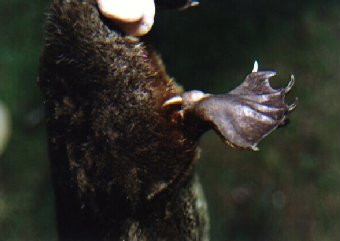
Like the panda's thumb (this one, not this one), the venomous spur is not a modified toe, but is anchored to a modified ankle bone. The spur is visible in this photo (Fig 2) and in this skeletal specimen (Fig 3) from the Melbourne Museum.

Figure 2: Hind leg, showing the spur. [Source]

Figure 3:  Platypus skeleton.  Note the number of hind toes and the venomous spur. [Source]

Finally, it's hard to talk about all the curious details of the platypus without touching upon the problems these organisms have historically posed for creationists.  For example, see this entry at SkeptiWiki and this slightly longer article at TalkOrigins.org.

Why Darwin Still Matters

Thursday, May 13, 2010 at 6:00 PM Bookmark and Share
Here's a thought provoking talk on Why Darwin Still Matters, given by Warren Allmon, director of the Paleontological Research Institute & Museum of the Earth and professor at Cornell University.


Follow-up on Anti-Evolution Policital Attack Ad

Wednesday, May 12, 2010 at 8:11 PM Bookmark and Share
An update following my earlier post.  I had suspected Tim James was behind the ad, but it turns out someone else helped foot the bill...

It looks like the responsible party is the True Republican PAC which is financially backed by -- get this -- a teachers' union and affiliate of the National Education Association, the Alabama Education Association (AEA).

Yup, that's right, it appears a bunch of Alabama public school teachers (unknowingly, I presume) helped pay for an ad lambasting the Governor because "he supported the teaching of evolution" (gasp!) and because he may not believe in a literal interpretation of the bible.

Alabama Policital Attack Ad Mocks Evolution?

Tuesday, May 11, 2010 at 10:33 PM Bookmark and Share
I've been including a lot of definitions in posts lately, so here's another one inspired by this post over at Panda's Thumb.
Poe's Law
  1. The eponymous law of the internet, that "Without a winking smiley or other blatant display of humour, it is impossible to create a parody of [religious] fundamentalism that someone won't mistake for the real thing."
  2. "Poe’s Law also has an inverse meaning, stating that non-fundamentalists will often mistake sincere expressions of fundamentalist beliefs for parody."[Source]
Here's an example of what I'm really hoping is a case of #1, but sadly appears to be a case of #2...


Please someone tell me this is either a joke, or that the candidate behind the attack is unlikely to ever hold the Governor's office!  Who might that be?? I'm guessing Tim James -- yes that same Tim James who wants Alabama to be English-only.

Seriously, it almost makes me want to send a campaign donation to Bradley Byrne... almost.

Click here for an update.

Mid-week Reptilian #16: New Species of Monitor Lizard!

Wednesday, April 7, 2010 at 1:45 PM Bookmark and Share
I love monitor lizards (if you haven't already suspected as much). They're just so intelligent, physically impressive, and generally handsome little (ok, in some cases huge) lizards that I don't see how someone could look into their eyes and not be captivated by them.

You might think that all monitor species pushing 6 feet in length have been discovered by now, but recent news (here, here, here, y aquí) out of the Philippines provides a nice reminder that there is still much in the world we have yet to discover and understand. 

Meet the latest addition to the list of known varanids, Varanus bitatawa (aka the Northern Sierra Madre Forest Monitor):

 Figure 1: Now isn't this V. bitatawa just the cutest thing you've ever seen? 
I mean, this kind of cute just eats up any of the competition! [Source]


The find was published today in Biology Letters (links below), though I haven't had a chance to read it yet.  The discovery itself is pretty big news, but the story gets better!!  These rather large monitors also have some pretty interesting ecology:  they're arboreal and (unlike almost all other monitors, which are carnivores) their diet is at least partly composed of fruit!!

Figure 2: More reptilian cuteness, which was probably followed 
by the photographer getting a nice tail lashing. [Source]

References:

  1. L.J. Welton, C.D. Siler, D. Bennett, A. Diesmos, M.R. Duya, R. Dugay, E.L.B. Rico, M. Van Weerd, R.M. Brown. 7 April 2010. A spectacular new Philippine monitor lizard reveals a hidden biogeographic boundary and a novel flagship species for conservation. Biology Letters. doi:10.1098/rsbl.2010.0119

Carnival of Evolution #22 ...

Tuesday, April 6, 2010 at 12:53 PM Bookmark and Share
... is up at Ted MacRae's blog Beetles In The Bush.  Check it out!

I'm busy enough trying to keep up reading just a handful of blogs (via Google Reader) so I have avoided blog carnivals in the past.  After skimming this one, I might have to make an exception to that rule.

[Hat tip to Jason, The Thoughtful Animal]

The Power of Genetic Variation

Thursday, April 1, 2010 at 10:27 PM Bookmark and Share
Despite creationist claims to the contrary, living organisms are capable of producing offspring with shockingly different genomes than their parents.  Though often harmful, such changes provide the kind of heritable variation needed for evolution to work.

Just as Darwin gained great insights into heritable variation and natural selection from his study of domestic animals and plants, researchers today are still learning quite a bit about how the natural world works by studying domestic and model organisms.  Here's a recent example, courtesy of UC Davis via their YouTube channel:


I once asked a creationist pseudoscientist (who had just given a talk in which he'd made the silly claim that mutations don't add new information to a genome) why something like the doubling of an entire genome doesn't count as a change in information.  Now, I've previously mentioned the kind of "information" creationists like to talk about and, like clockwork, this guy responded to my question by whipping out out the most ridiculous definition of "information" I've ever seen misapplied, ever.

It should have been an epic embarrassment for him, but he didn't even seem to recognize how utterly dumb he had just made himself look. But hey, maybe some people would rather be right than be considered honest or rational. I wonder... would he consider losing half your genome a loss of information?

New Website on Human Evolution

Friday, March 12, 2010 at 10:36 PM Bookmark and Share
On March 17th, the National Museum of Natural History will open the David H. Koch Hall of Human Origins. Leading up to that opening, the Smithsonian Institute has launched a new website on human origins that's well worth checking out.

Figure 1: "Staring contest... ready, go!"

The website includes a look into the evidence of our ancestry, research news, information for teachers and students, upcoming events and exhibit information (if you're ever in the neighborhood, ), and a section on "Religious Perspectives":
The Hall of Human Origins offers a welcoming place to explore one of the most exciting areas of science, the study of human evolution. Despite strong public interest in the science, however, many people find this topic troubling when viewed from a religious perspective. Representatives of diverse religious communities encourage a larger, more respectful understanding of both the scientific evidence and religious belief.
No doubt some will find this sort of language a bit too friendly to any religious claims regarding human origins, but given the Smithsonian's role as an educational institution I can appreciate their pragmatism. Reading a bit further (emphasis added)...
There are a number of different approaches to the science-religion relationship. One approach is to see science and religion as separate domains that ask different questions focusing on separate interests in human life – for example, about the natural world in science and about God in religion. This approach depends on respecting and maintaining the distinctions but can sometimes overlook the ways in which scientific interpretations may have an effect on religious beliefs. Conflict is seen to arise when efforts are made to eliminate the separation that the first approach assumes. The strongest conflicts develop when either science or religion asserts a standard of truth to which the other must adhere or otherwise be dismissed.
This I like. I'm quite fond of using science and rational thought to understand the world, while keeping that knowledge distinct from any contrary claims based on religious beliefs.  The website continues ...
An alternative approach sees interaction or engagement as positive. Engagement takes many forms, including personal efforts by individuals to integrate scientific and religious understandings, statements by religious organizations that affirm and even celebrate the scientific findings, and constructive interactions between theologians and scientists seeking common ground, respect, and shared insight into how the science of human evolution contributes to an awareness of what it means to be human. 
So what do you think - too accommodating of religion, or did they do a good job of addressing religiously motivated objections to the claims of science? 

[Hat tip to Panda's Thumb]

Mid-week Reptilian #12: Struthio camelus

Wednesday, March 3, 2010 at 10:36 AM Bookmark and Share
As the heaviest and tallest living bird, the Ostrich (Struthio camelus) is probably the most familiar of all flightless birds second only to penguins. While flightlessness has evolved numerous times in a variety of different bird groups, it's the norm among Ostriches and their closest relatives - the ratites.

Most people are familiar with these big, showy, eye catching animals. They are common in zoos, frequently seen images in popular media, and recently have even gained popularity as livestock (drumstick, anyone?).  Ostriches commonly appear in documentaries, such as this recent appearance (as cat food) in the latest BBC series, Life (see below).  

 
(Americans apparently can't handle Attenborough, so unfortunately we get Oprah instead. )

As you may have already noticed, Ostriches aren't just some stretched out version of your typical bird. So what makes them so distinct? To fully appreciate what makes these towering descendants of dinosaurs so darn interesting, it helps to look into their evolutionary history -- one that is shared with their closest living relatives, the other ratites.

Ratites are a group of flightless birds (order Struthioniformes, though some elevate the families below to order status) spread out over South America, Africa and Australasia.  They're a great example of allopatric speciation, with the different species having diverged from one another as the continents spread apart during the past hundred million years or so.


Figure 1: Pangea breaking up starting at ~225 million years ago.

As a group, the taxonomic relationships within the ratites falls cleanly over their geographic distributions.  Excluding extinct species like the freakishly huge Moas, and other groups that have recently been associated with the ratites (i.e., the Tinamous), their distributions are as follows: 

Australasian Ratites

1. Family Cassuariidae
  • Emu (Dromaius novaehollandiae)
  • Cassowary (3 species; Southern Casuarius casuarius, Dwarf C. bennetti, Northern C. unappendiculatus.)
2. Family Apterygidae
  • Kiwis (5+ species, all in the genus Apteryx)

African Ratites

3. Familiy Struthionidae
  • Ostrich (Struthio camelus) 

South American Ratites

4. Family Rheidae
  • Rheas (2 species; Greater Rhea americana, and Lesser R. pennata)
Along with having lost the ability to fly, ratites possess unkeeled breast bones reduced or absent furcula (wishbones), a stronger more dense bone structure, and legs that are well suited to walking and running.  Besides such adaptations for life as a terrestrial biped, Ostriches and other ratites also have what is perhaps the coolest and most under-appreciated feature - vestiges of their dinosaurian origins: they have vestigial claws on their wings.

If that's news to you, lets just say it out loud one more time:  Ostriches have claws!!

Figure 2: Details of the wingtip of the Ostrich, drawn circa 1898.
[Source: The structure and classification of birds (full text).]

Fortunately for zoo visitors and Ostrich farmers, they didn't retain TOO many of their ancestors' other dinosaurian features. Imagine getting a bite from one of these!

 
Figure 3:  The ostrich farmer's worst 
nightmare: avian atavism!  [Source]