Showing posts with label science basics. Show all posts

Data Visualization: 200 Years of Health and Wealth

Wednesday, December 15, 2010 at 10:48 PM Bookmark and Share
This video is super awesome!  It's part of BBC 4's program The Joy of Stats and you can learn a little more about the data here or play with it using this web app on http://www.gapminder.org/. Now don't you wish you could do that with data?


The reason I wanted to share this video (beyond the fact that it's so amazingly awesome) is to let you in on a little secret... are you ready? Here it comes...
Data visualization is easy, and anyone with a computer can do it!
Seriously, it is not that hard! YOU can make cool little wobbling bubble graphs just like in the video! Aren't you excited to learn how?! Yeah? Fantastic!

Now that you're all psyched to visualize some data, I should mention that I am being a bit misleading here... because it does require a bit of computer know-how, and sometimes (ok, almost always) takes a bit of tinkering with the data to find the best ways of boiling down to just the relevant information. But frankly, these things aren't all that hard to learn and aren't always necessary if we're just poking around to get a feel for the data, so none of these words of caution should give you much pause.  Add to that the fact you can always hit up the internet for examples to download and use study and learn from and many of these obstacles are reduced to mere speed bumps.  If you've got a computer, we can get it to plot some data.

Figure 1. Tourist hot spots based on Flickr data. #1 of flowingdata's Top Ten Data Visualization Projects of 2010.

So here's the deal... there are some really cool data available from http://www.gapminder.org/, and I'm going to have a little free time these next few weeks in between birding trips, visiting family and friends, and doing thesis work.  Assuming that free time stays free, I'm going to walk through an example or two of plotting some of this data in R.  If you'd like to follow along, you'll need to download and install R on your computer, and if you don't already have software that can open excel spreadsheets, you'll also want to install something (free) like OpenOffice.

Sound good? Excellent!  Feel free to share any questions or suggestions in the comments section below.  Now hurry along and go install R!

Using Reptiles For Public Education, Outreach

Monday, November 8, 2010 at 8:20 PM Bookmark and Share
Melissa Kaplan has a great website regarding reptiles in captivity, and included among her writing is some great advice for using animals in public outreach and education. Though geared towards reptiles, the comments I think apply broadly -- check it out!

Talk on The Math, Physics of Drag Racing

Friday, October 29, 2010 at 5:00 PM Bookmark and Share
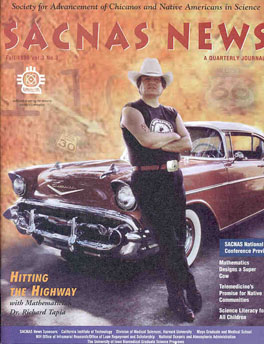
Thursday (4 Nov) there is a public lecture at COSI in Columbus you don't want to miss.  The talk will be given by Dr. Richard A. Tapia -- a big name in applied mathematics, an entertaining speaker, and long-time "champion of under-represented minorities in the sciences."

Tapia has received numerous professional and community service honors and awards including the annual Blackwell-Tapia Conference being named in his honor (his reason for visiting Columbus) and being inducted into the Texas Science Hall of Fame (yes, such a thing really does exist!).

Here are the details of his talk from the event flier (PDF):

Math at Top Speed: Exploring and Breaking Myths in the Drag Racing Folklore

November 4, 2010; 7:00pm @ COSI (doors open @ 6:00pm) Admission is free

For most of his life, Richard Tapia has been involved in some aspect of drag racing. He has witnessed the birth and growth of many myths concerning dragster speed and acceleration. Some of these myths will be explained and validated in this talk, while others will be destroyed. For example, Dr. Tapia will explain why dragster acceleration can be greater than the acceleration due to gravity, an age-old inconsistency, and he will present his Fundamental Theorem of Drag Racing. Part of this talk will be a historical account of the development of drag racing and several lively videos will accompany this discussion.

Speaker: Richard Tapia
University Professor Maxfield-Oshman Professor in Engineering, Department of Computational and Applied Mathematics (CAAM), Rice University

More about Dr. Tapia can be found here, here, and here.  More on the Blackwell-Tapia Conference can be found by clicking the "Blackwell-Tapia" link on this website.

How many species concepts are there?

Thursday, October 21, 2010 at 11:00 AM Bookmark and Share
Do you remember the definition of species from your high school or college biology class?  Me neither -- but worry not!  Even if you remembered it word for word, there's a good chance it's not the same definition your friends and co-workers learned and it's certainly not the only definition floating around out there.  So how many species concepts are there?

According to John S. Wilkins in his recent guest post over at Punctuated Equilibrium (also here on John's blog) there are either 26-27, 7, 2, 1 or 0.  The article is well worth the read as John gives a nice, brief overview of the many different definitions of a biological species, their similarities and differences, and the key concepts behind those definitions. 


If you don't mind my giving away the punchline, here's what it all boils down to:

Final score: 26-27, 7, 2, 1 or 0.

What to think? My solution is this:

There is one species concept (and it refers to real species).

There are two explanations of why real species are species (see my microbial paper, 2007): ecological adaptation and reproductive reach.

There are seven distinct definitions of "species", and 27 variations and mixtures.

And there are n+1 definitions of "species" in a room of n biologists.
For a more detailed treatment of the idea of biological species, see John's book 'Species: A History of the Idea'.

[Hat tip to John Hawks and GrrlScientist]

Christine O'Donnell: "Where in the Consitution is the Separation of Church and State?"

Wednesday, October 20, 2010 at 5:50 PM Bookmark and Share
Christine O'Donnell is shockingly ignorant when it comes to science, creationism, and now apparently ( ... drum roll please ... ) the U.S. Constitution.

Don't take my word for it, here it is straight from the witch's horse's mouth...

(Her shockingly dumb question occurs just after the 2:30 mark in the video.)

[Hat tip to Sandwalk]

More on what Fodor and Piattelli-Palmarini Got Wrong

Friday, July 30, 2010 at 12:12 AM Bookmark and Share
Jerry Fodor and Massimo Piattelli-Palmarini have received quite a bit of criticism since the publication of their book What Darwin Got Wrong, which attempts to argue that evolution by natural selection is basically nonsense.  The consensus seems to be that Fodor and Piattelli-Palmarini don't understand modern evolutionary theory, and that they're plainly wrong. However, in case you think they might be onto something you should check out this July 2010 critique of their book, which also takes them to task for getting it wrong.  The review is written by Harvard philosopher Peter Godfrey-Smith. You should of course click over to the review and give it a good read, but I thought I'd comment here on a few highlights.

Peter begins by recalling a young Noam Chomsky's scathing book review of B. F. Skinner's 1957 book Verbal Behavior, which seems to have rightfully blown those ideas right off the map.  He suggests there is a parallel here, to what Fodor and Piattelli-Palmarini seem to have attempted with their book... except this time it's they who have it wrong.
... A young linguist, Noam Chomsky, published a review of Verbal Behaviour... It was perhaps the most devastating book review ever written.

Chomsky argued that Skinner’s theoretical vocabulary could be applied to human linguistic behaviour only in an empty, post hoc way. He also thought that Skinner’s behaviourism had a simple architectural flaw: it held that external factors – especially experiences of reinforcement – were of ‘overwhelming importance’ in the explanation of behaviour. Hardly any role was given to what Chomsky referred to simply as ‘the internal structure of the organism’. It is unusual to do serious damage to a scientific research programme with a set of general arguments – not by citing experimental or mathematical results, but by looking at the basic ideas and revealing a crack in the foundations. Though the impact of the review itself is sometimes exaggerated, this is the effect Chomsky had on the behaviourist study of humans.

Jerry Fodor now hopes to do something similar to Darwinism in biology. Fodor has been making sceptical remarks about Darwinian ideas for decades. Three years ago he wrote a direct attack on Darwinian evolutionary theory in the LRB, and he has now published What Darwin Got Wrong, along with Massimo Piattelli-Palmarini. Fodor and Piattelli-Palmarini believe that they can replicate Chomsky’s demolition job on Skinner because ‘Skinner’s account of learning and Darwin’s account of evolution are identical in all but name.’ As we shall see, ‘identical’ is quite a stretch, but there is a real analogy.
Peter then recounts the criticism others have made of Fodor and Piattelli-Palmarini, specifically the argument that natural selection needs to be an 'intensional process' that can distinguish between 'co-extensive' properties of organisms (translation: natural selection allows correlated traits to piggy back advantageous traits, and this somehow implies natural selection doesn't work...)  Now, while there's a more to the book than that (again, see the review for details) this argument sounds so blatantly wrong that I wonder if I'm even understanding it correctly!  I mean really?  Correlated neutral traits are the big showstopper for natural selection? Sadly, I don't think I'm wrong. This really appears to be part of their argument!  If that's true, then the book What Darwin Got Wrong should be given the more appropriate title, What Fodor and Piattelli-Palmarini Got Wrong.

Now, I'm not just making this interpretation up... and neither is Peter Godfrey-Smith.  Here's what F&P-P had to say in their response to an earlier criticism by Block and Kitcher (links below, emphasis mine):
For example, suppose random variation produces a trait that tends to make its bearers invisible to their predators. Then, all else equal, the predators gobble up the creatures that don’t have it, and the relative frequency of the trait in the population increases from generation to generation. To repeat, we haven’t the slightest doubt that this is the process that Darwin called natural selection and that Darwinists have always believed in some or other version. In fact, it sounds pretty good. It sounds like it ought to work.

But it doesn’t. A way to see that it doesn’t (not by any means the only way) is to consider confounded (linked) phenotypic traits, one but not the other of which is fitness-enhancing. Both traits are then correlated with fitness, so both should count as adaptations according to the formulation of natural selection given above. But only one of them is a cause of selection, so only one of them is an adaptation, and, though both are selected, only one is selected-for. Thus the free-rider problem. Prima facie, free riding is a counterexample to natural selection.
Massive sadness... They botched it.  Prima facie, Fodor and Piattelli-Palmarini are simply confused about modern evolutionary biology (which is forgivable) and publicly wielding some philosophical sledge hammers at it, creating some confusion in their wake (this fact is way less forgivable, in my opinion).

Peter I think sums it up nicely when he writes...
Fodor and Piattelli-Palmarini criticise the tendency to talk of selection as if it were an agent. They are right that this is often misleading, but they seem to be making a similar mistake when they treat it as something over and above the ordinary facts of life, death and reproduction.
After all, recalling how natural selection works in a population, there really isn't much more to it that "life, death and reproduction." Just combine (1) some variation that is (2) heritable with (3) those variants achieving differential reproductive success.  Let that process run for a few generations, and blammo - evolution happens. The distribution of variation in the population changes and the rest is (natural) history. Darwin nailed it, over a century worth of scientific progress has confirmed it, yet unfortunately it appears Fodor and Piattelli-Palmarini simply got it wrong.

But... perhaps one day they'll recognize their mistake, do the right thing, and admit they were wrong?  After all, they themselves say in their reply to Block and Kitcher (again, emphasis mine)...
Everybody makes mistakes. Even biologists do; even lots of biologists assembled together do; even great biologists like Darwin do...
Yes, gentlemen, so do very respectable cognitive scientists and philosophers, even those not unlike yourselves.

Related Links

  1. Misunderstanding Darwin: Darwin's Secular Critics Get It Wrong | Great critique by Block and Kitcher.
  2. "Misunderstanding Darwin" An Exchange. | Dialogue where Fodor and Piattelli-Palmarini Respond

How to disprove evolution

Thursday, July 29, 2010 at 12:30 AM Bookmark and Share
... according to a Texan.


Oh, right, I should of course mention that this particular Texan is a wickedly sharp scientist and creator of some hugely popular YouTube videos on creationism, evolution and science education. Nothing wrong with knowing how to disprove a scientific theory - after all, that's how science works!

Now head on over and check out AronRa's youtube channel for more of his great videos.

Paul Pick's Spain

Friday, July 9, 2010 at 12:27 PM Bookmark and Share
I don't follow professional sports much, so I was a little confused to read on Jerry Coyne's blog that apparently I had chosen Spain, and that Jerry agreed.  Then I realized he was of course talking about Paul the cephalopod, not Paul the grad student who should be writing his thesis right now instead of blogging.

Despite the fact that I'll be content to see either country win, Jerry was right!  I really did end up picking Spain!  I didn't have an octopus handy, and no coins within reach of my computer, so I just used R to do the coin toss. See for yourself...
> date()
[1] "Fri Jul 09 12:09:24 2010"
> set.seed(09072010)
> ifelse(runif(1) <= 1/2, "Spain", "Netherlands")
[1] "Spain"
> 
See, Spain wins!  Wow - I mean really, what are the odds?

Elements of Math, by Steven Strogatz

Thursday, July 8, 2010 at 12:19 AM Bookmark and Share
Courtesy of the editors at the New York Times Opinionator blog:
Professor Strogatz’s 15-part series on mathematics, which ran from late January through early May, is available on the “Steven Strogatz on the Elements of Math” page.
Go check it out! Strogatz is an excellent speaker and writer, and any minute spent reading his writing is a minute very well spent.

The self-correcting nature of science: a recent example

Thursday, October 29, 2009 at 6:14 PM Bookmark and Share
Science has a built in mechanism by which it can root out false or baseless assertions put forth by - well by anyone - but especially by members of the scientific community.


At it's core, science demands that ideas be challenged with empirical evidence and logical reasoning.  For practitioners (whether career scientists or otherwise) there is then an assumed responsibility to ensure those core demands are properly put into practice. This results in a kind of social norm among scientists that they are critical of one another, and that they hold themselves and their peers to the highest standards of scientific inquiry.  The result?  If it doesn't pass muster, it won't get past too many people before someone cries foul.

Over at the blog Why Evolution is True there's a nice, recent example where you can see this process in action.

The mice of Gough Island: Opportunity knocking!

Thursday, February 19, 2009 at 1:59 AM Bookmark and Share
These large, carnivorous, non-native cousins of the ubiquitous house mouse (Mus musculus) are about to get scrubbed off of Gough Island in the south Atlantic as part of measures to protect the seabirds that breed there. But before they go, we get the opportunity to study the evolution and ecology of one of the most well studied vertebrates in the lab, only this time - mother nature has done the experiment for us!

If you try and read up on the mice of Gough Island (e.g. google “Gough” and “mouse”), you’ll hear about the damage they are doing to the island’s nesting sea birds – some of which are of great concern as they are not known to nest anywhere other than this one island.

The mice of Gough Island have a different story. They were accidentally introduced by ships in the 19th century, and have since become larger in size than the typical house mouse, weighing in at a whopping 35g (normal mice are nearly half that size)! If you’re curious as to how they have reached this size, consider their life on Gough Island. There are no large predators, and their diet includes a hearty (though seasonal) food source: seabird chicks! And we aren’t just talking about hapless, naked, sparrow-sized birds here - some of them (such as albatross) are as large as a turkey!

Interestingly, this is a classic example of what some call the "island rule" for the evolution of body size: small animals seem to evolve to be larger than their mainland counterparts, and large animals tend to be smaller. This from the sizable body of knowledge arising from studies of the evolution of body size (which, for example, might occur in response to resource limitation, sexual selection via competition for mating opportunities, predation, and even predation by humans).

Super-sized or not, in order to protect the island's breeding seabirds from this jumbo sized pest, the UK has awarded The Royal Society for the Protection of Birds (a conservation organization) funding to eradicate them from the island, and most of the world seems to be quite pleased about it.

"But wait!"

In our effort to save the seabird colonies (which I fully support, I’ll have you know) we may be destroying a fantastic opportunity to learn something from what scientists call a natural experiment - a situation that arises in nature but can reveal to us the kind of information we might hope to get from specifically designed scientific experiment. In this case, the evolution of a wild population that has been adapting to a new environment over the better part of a century or more.

So why is this particular population so noteworthy? I’m glad you asked! First, there been very significant phenotypic changes in this population (suggesting there are likely to be interesting genetic or other evolutionary changes in the population that are worth studying) - fortunately, people are already hard at work studying these hefty little rodents. Second, we know about some of the major aspects of the ecology and natural history of this population - an important first step to understanding the role their environment has played in shaping the evolutionary trajectory of the population.

If that doesn't seem promising enough, the house mouse is probably the most well studied vertebrate on earth! Taking the tools and insights gleaned from studying from studying mice in the laboratory and combining them with studies of wild populations seems like a promising approach to advance our understanding of evolution in wild populations.

So, as we embark on ridding this island of its pesky rodent problem, I do feel a little bummed to see a monkey wrench thrown into the system. What would those mice look like in another century? As much as I would love to know, however, the price of loosing even one of the sea bird species that nest there would be far to great a cost!

If the links above have left you wanting more, check out the Payseur Laboratory website for some of the work on understanding more about the mice of Gough Island, and the Global Invasive Species Database which includes video of mice attacking an Albatross chick.