Showing posts with label wildlife. Show all posts
Showing posts with label wildlife. Show all posts
Using Reptiles For Public Education, Outreach
Monday, November 8, 2010 at 8:20 PM

Labels: conservation, education, kids, reptiles, science basics, wildlife
Labels: conservation, education, kids, reptiles, science basics, wildlife
Melissa Kaplan has a great website regarding reptiles in captivity, and included among her writing is some great advice for using animals in public outreach and education. Though geared towards reptiles, the comments I think apply broadly -- check it out!


In which a family cheers at the suffering and death of an animal...
Monday, September 27, 2010 at 12:15 AM
Labels: being human, conservation, education, ethics, humans vs nature, reptiles, wildlife
Labels: being human, conservation, education, ethics, humans vs nature, reptiles, wildlife
Science is cold, emotionless. It takes no moral positions, it has no fears, it's just a method for rooting out incorrect ideas by challenging those ideas with logic and data. This is a good thing: it's what makes science so successful at giving us relatively objective descriptions of reality and how it works.
But scientists aren't science. They do hold moral position, and sometimes they give a damn about something. That means the things they care about - be it puppies, women's rights, great music, historical buildings, or hot shoes - these things evoke emotion, and dictate action. Personally, I'm rather partial to snakes, which is why my blood boils when I watch this video of a family cheering as passing traffic repeatedly hits and eventually kills an Eastern Diamondback Rattlesnake...
Interestingly, I don't hate these people - I don't even dislike them (which I'll admit feels a bit odd - I feel like I should). Certainly, if I were in their shoes, I would have jumped out of the car and tried to saved the snake. But that's me - I know a fair bit about rattlesnakes, and through that knowledge I've developed a great deal of appreciation for them.
That's important, so I'll reiterate: my knowledge of snakes has brought me to appreciate them. Science may be cold and emotionless, but the factual details it provides can significantly shape our morality - our sense of good and bad, right and wrong - and I think this is generally true for nearly everyone. I'll let Richard Dawkins and Sam Harris elaborate (although see Massimo Piggliucci's commentary for a critique of Harris's talk)...
So when I see videos like the first one above, I don't see an evil family of ruthless sadists raising sociopathic children. In fact, I'd be surprised if they weren't actually a rather likable and otherwise decent family.
What I do see is a family that doesn't live near a good nature center. That doesn't spend much time at high quality zoos. That lives where the schools have ineffective biology teachers. A family with no pet reptiles, maybe no pets at all. Mom and dad are almost certainly not biologists, probably don't get out into nature much, and the kids probably don't want to become doctors or social workers or biologists (yet!).
What I see is the target audience of every science and nature educator ever to speak to the public.
Ignorance is the problem, education the solution.
Oh no! I (almost) missed IRFD, 2010!!!
Sunday, September 12, 2010 at 10:40 PM
Labels: amphibians, arthropods, ecology, education, nature, reptiles, wildlife
Labels: amphibians, arthropods, ecology, education, nature, reptiles, wildlife

So what's a thesis-writing, easily distracted grad student to do? Why run outside and flip some rocks, of course. Pics will be posted below once I get them cropped and uploaded to the intertubes.
[Brief pause while I run outside with a camera and flashlight...]
Turns out, there aren't too many rocks worth living under in our yard - and the few that are are a bit on the huge end of the spectrum. Still, I managed to snap some decent photos of a few of the invertebrates living around our house. Pictures will be posted below tomorrow.
Photos of Wildlife Affected By The BP Oil Spill

Check out the photos below, for example, and if you're an ID-fiend feel free to take a stab at identifying these species (speculation and/or solid IDs are welcomed in the comments section).
On a side note, the media has basically been shut out of most of the affected areas. This basically cuts off public access to these kinds of images which portray the huge impact the oil spill is having on coastal and marine ecosystems. Images like those below or others like these from the Boston Globe, are less common in the press than they should be - so do take some time and check them out.
Photo #1:
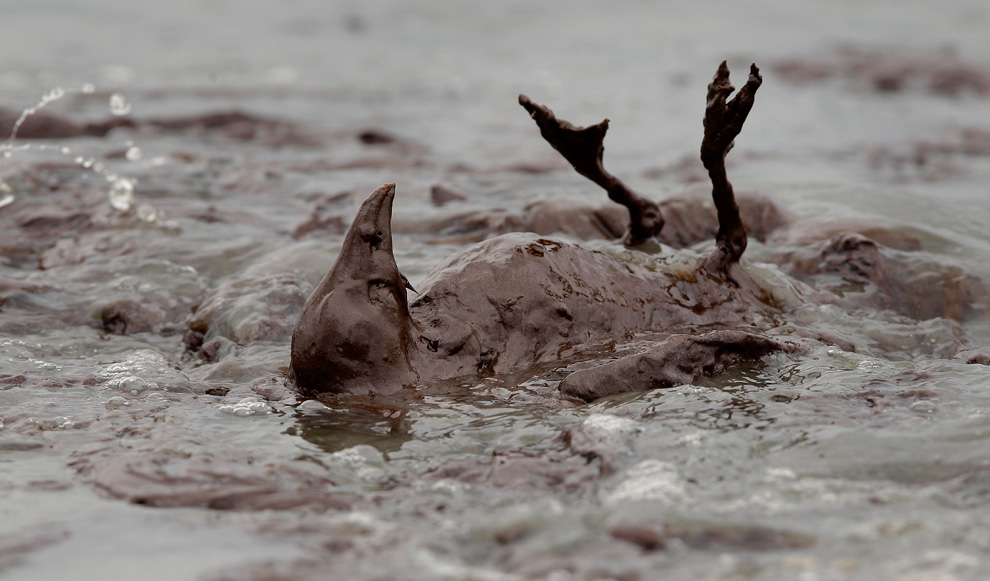
A bird covered in oil flails in the surf at East Grand Terre Island along the Louisiana coast Thursday, June 3, 2010. (AP Photo/Charlie Riedel)
Photo #2:
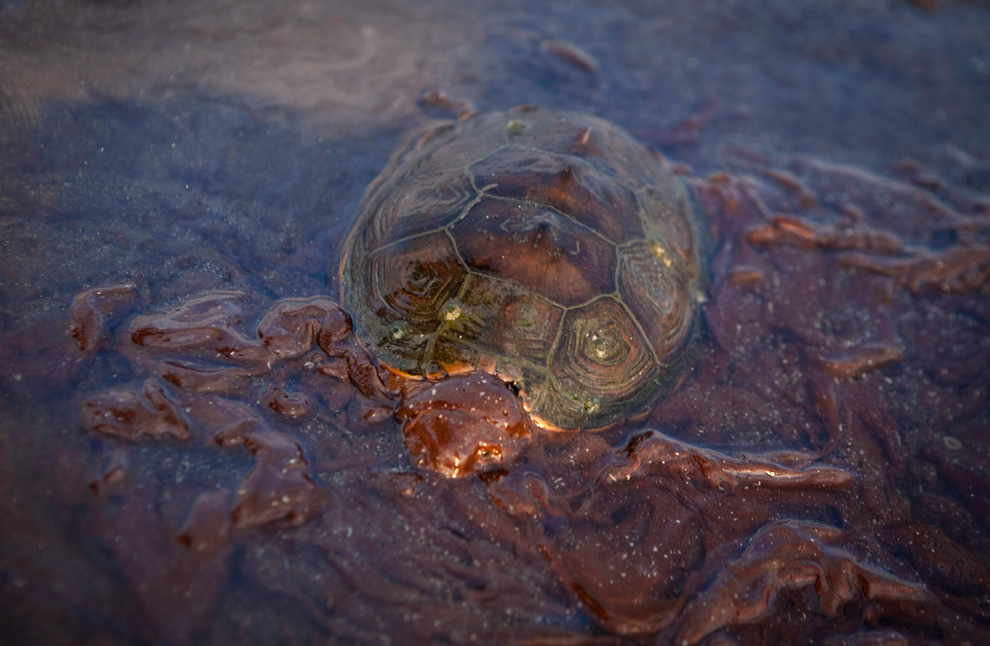
A sea turtle is mired in oil from the Deepwater Horizon oil spill on Grand Terre Island, Louisiana June 8, 2010. (REUTERS/Lee Celano)
Photo #3:

An oil soaked bird struggles against the oil slicked side of the HOS Iron Horse supply vessel at the site of the Deepwater Horizon oil spill in the Gulf of Mexico off the coast of Louisiana Sunday, May 9, 2010. (AP Photo/Gerald Herbert)
Photo #4:
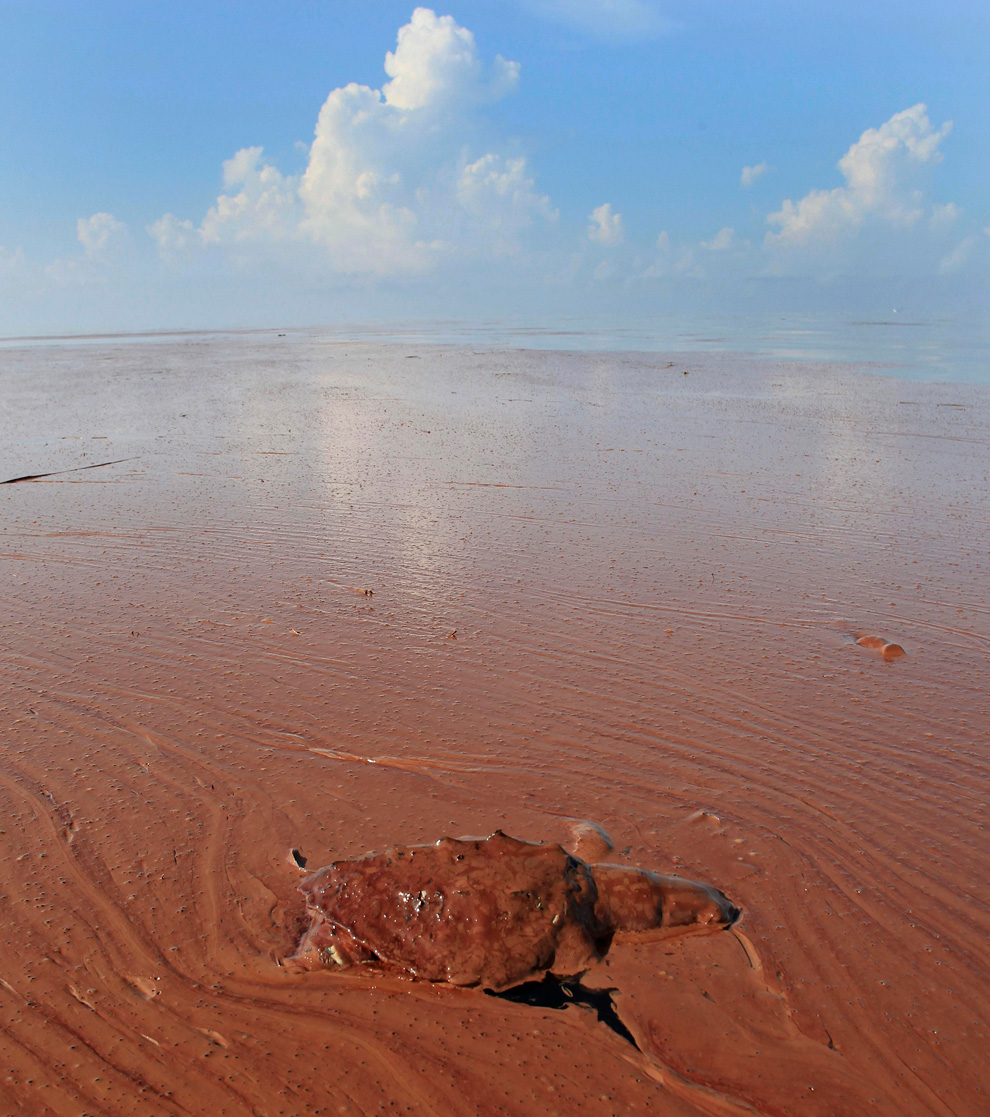
A dead turtle floats on a pool of oil from the Deepwater Horizon spill in Barataria Bay off the coast of Louisiana Monday, June, 7, 2010. (AP Photo/Charlie Riedel)
Capturing a Record-breaking Burmese Python in Florida
A couple of months ago, non-native Burmese Pythons (Python molurus bivittatus) began their breeding season in Florida -- at least the few who survived the large die-off this past winter. By exploiting the breeding ecology and behavior of these hefty reptiles, wildlife managers use radio (or GPS?) tagged males to track down other pythons as part of their efforts to remove this invasive population.
In this post over at fieldherpforum.com, one member of a field crew has shared some photos and video from one such trip, where a tagged male lead the crew to a mating ball of five snakes: the tagged male, three additional males, and one ginormous female. The big girl came in at a whopping 16'9" long and 134lbs!

Here's one photo of that tangled mass of snakes, plus some video just before and after the roundup.
Amazing Story from Gorilla School
A brief "must watch" video of a Damian Aspinall's visit with a western lowland gorilla (G. g. gorilla) which he helped raise and reintroduce to the wild. The video is part of the Animal Planet series Gorilla School.
More about donating to help support gorilla conservation can be found at the Aspinall Foundation website, here or from other organizations such as the International Gorilla Conservation Programme, the Dian Fossey Gorilla Fund, and the Mountain Gorilla Conservation Fund.
[Hat tip to Dr. Tom]
"Damian Aspinall's Extraordinary Gorilla Encounter on Gorilla School"
More about donating to help support gorilla conservation can be found at the Aspinall Foundation website, here or from other organizations such as the International Gorilla Conservation Programme, the Dian Fossey Gorilla Fund, and the Mountain Gorilla Conservation Fund.
[Hat tip to Dr. Tom]
Monday Mammal #4: Coati
While most folks in North American are familiar with the Common Raccoon (Procyon lotor), few ever get to know their cousins the coatis. The name coati refers to a number of species in two genera: Nasua (coatis; 3 species) and Nasuella (mountain coatis; 1+ species). They are members of the Racoon family Procyonidae comprised by the Raccoons (3 species), Ringtail & Cacomistle, Olingos, and the Kinkajou. Like all members of this family, the coatis are native only to the Americas.
In the U.S., you could possibly find the northern most coati (Nasua) species -- the White-Nosed Coati (Nasua narica) -- which occurs from south eastern Arizona down to northern South America. The other two species occur on the island of Cozumel and in South America, respectively. The mountain coatis (Nasuella) occur in northern South America.
Here's a South American Coati (Nasua nasua) photographed at the Denver Zoo when I last visited there in July, 2009. This widespread omnivorous species includes over a dozen subspecies.
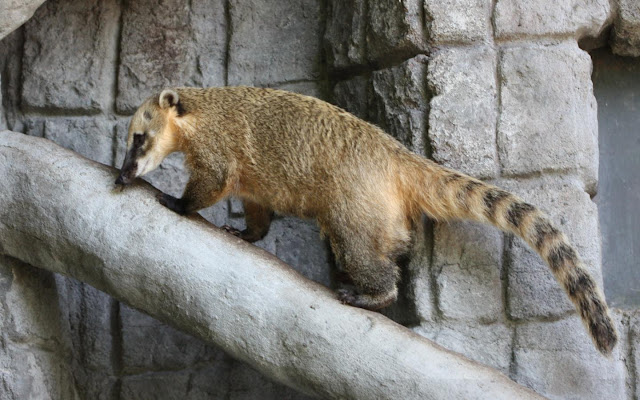
For more info and pictures of Procyonids, visit the University of Michigan's Animal Diversity Web: Family Procyonidae.
In the U.S., you could possibly find the northern most coati (Nasua) species -- the White-Nosed Coati (Nasua narica) -- which occurs from south eastern Arizona down to northern South America. The other two species occur on the island of Cozumel and in South America, respectively. The mountain coatis (Nasuella) occur in northern South America.
Here's a South American Coati (Nasua nasua) photographed at the Denver Zoo when I last visited there in July, 2009. This widespread omnivorous species includes over a dozen subspecies.

For more info and pictures of Procyonids, visit the University of Michigan's Animal Diversity Web: Family Procyonidae.
Monday Mammal #3: West Indian Manatee
To showcase some of the wildlife impacted by gulf coast oil spill (see this post), this week's Monday Mammal is one that will likely be affected by the spill: The West Indian Manatee (Trichechus manatus).

The West Indian Manatee is one of 3 living manatee species, and one of 4 living species in the mammalian order Sirenia, which also includes the Dugong (Dugong dugon). These aquatic herbivores are thought to be most closely related to the elephant and hyrax, having evolved from land mammals a little over 60 million years ago.

These large animals (known to some as "sea cows") need to eat a huge quantity of aquatic vegetation, and it appears the oil spill could harm them by damaging the seagrass beds they rely on, in addition to whatever harmful effects might occur by ingesting or becoming covered in the oil.

To make matters worse, the late cold snap in the south eastern U.S. this winter has already taken a toll on the population. According to the Save the Manatee Club of Florida:

An adult West Indian Manatee with calf [Source]
The West Indian Manatee is one of 3 living manatee species, and one of 4 living species in the mammalian order Sirenia, which also includes the Dugong (Dugong dugon). These aquatic herbivores are thought to be most closely related to the elephant and hyrax, having evolved from land mammals a little over 60 million years ago.

Signs of their terrestrial ancestry include the toenails still present on their front flippers. [Source]
These large animals (known to some as "sea cows") need to eat a huge quantity of aquatic vegetation, and it appears the oil spill could harm them by damaging the seagrass beds they rely on, in addition to whatever harmful effects might occur by ingesting or becoming covered in the oil.
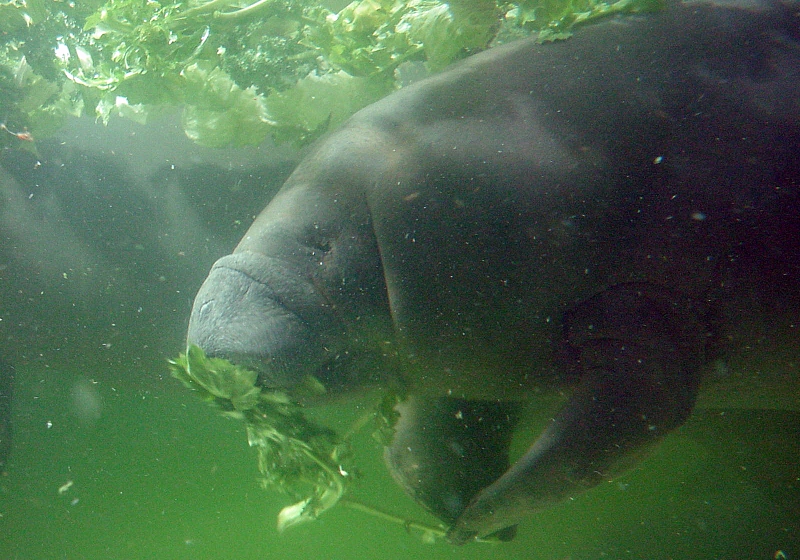
To make matters worse, the late cold snap in the south eastern U.S. this winter has already taken a toll on the population. According to the Save the Manatee Club of Florida:
[The BP spill] is especially troubling since it comes on the heels of the worst manatee winter die-off ever experienced, with over 500 total manatees dead already this year.You can read more about Manatees and Dugongs on the Sirenian International website and from the Save the Manatee Club. You can see more images of T. manatus from the wikimedia commons.
Mid-week Reptilian #17: Northern Water Snake (Nerodia sipedon)
Known for their eagerness to bite when handled (and the anticoagulant properties of their saliva), Northern Water Snakes are a common species throughout much of eastern and central North America (map). These snakes appear to either have evolved color patterns that mimic venomous snakes like the Cottonmouth (Agkistrodon piscivorus), or their coloration is simply a case of convergent evolution. Either way, many people are quick to kill any venomous snakes they encounter and the similarity between Nerodia sp. and some venomous snakes often costs the misidentified water snake it's life.
Below are a few photos of Ithaca, NY area Northern Water Snakes from July and August of 2009 (as always, click to enlarge). I was actually out trying to get bit when I took these, as I wanted to informally check out their anticoagulant saliva by comparing bites between these and comparably sized Eastern Garter Snakes (Thamnophis sirtalis sirtalis). The results? Well, I wimped out... all I could get close to were the larger water snakes and I wasn't THAT eager to see how much they could make me bleed. Hopefully I'll have better luck this year - ha!


Below are a few photos of Ithaca, NY area Northern Water Snakes from July and August of 2009 (as always, click to enlarge). I was actually out trying to get bit when I took these, as I wanted to informally check out their anticoagulant saliva by comparing bites between these and comparably sized Eastern Garter Snakes (Thamnophis sirtalis sirtalis). The results? Well, I wimped out... all I could get close to were the larger water snakes and I wasn't THAT eager to see how much they could make me bleed. Hopefully I'll have better luck this year - ha!

Figure 1: A largish individual getting ready to shed. Note the opaque eyes and overall faded look.

Figure 2: An even larger (female?) individual basking on a boulder in the middle of a creek.

Figure 3: A smaller (male?) found a few feet from the above female.
Monday Mammal #1: Pronghorn
I have a soft spot for cold blooded creatures, but that isn't to say I'm indifferent to those hot blooded, fur covered mammals. So what better use of all those mammal photos filling up my hard drive than yet another weekly series?
Yeah, same here - I couldn't think of anything better to do with them either - so weekly series it is! With that, I bring you the first Monday Mammal from my home state of Colorado: the Pronghorn (Antilocapra americana).

Quick story: Back when I was an undergraduate, I was lucky enough to help state wildlife officials in the capture and transport of some pronghorn from an area where they were in overabundance to an area looking to bolster their numbers.

Catching them went something like this...
If you'd like to know more about these unique critters, check out the Pronghorn page on the University of Michigan's Animal Diversity Web.
Update: For more, check out this fantastic post on "speedgoats" by Darren Naish over at Tetrapod Zoology.
(...brief pause to think about that question...)
Yeah, same here - I couldn't think of anything better to do with them either - so weekly series it is! With that, I bring you the first Monday Mammal from my home state of Colorado: the Pronghorn (Antilocapra americana).

Figure 1: A small herd of pronghorn around sunset in eastern Colorado in January, 2010.
This was shortly after Dr. Wife and I got hitched, and were headed to New Mexico for the
honeymoon. This group is feeding on walking stick cholla cactus (Cylindropuntia imbricata).
Despite being ruminant artiodactyls and bearing a close resemblance to true antelope (family Bovidae, along side cows and sheep), pronghorn are the only extant species in the family Antilocapridae and are apparently more closely related to giraffes and the okapi than anything else alive today. There are currently five recognized subspecies: the nominate American (A. a. americana), Oregon (A. a. oregona), Mexican (A. a. mexicana), peninsula (A. a. peninsularis), and Sonoran (A. a. sonoriensis).This was shortly after Dr. Wife and I got hitched, and were headed to New Mexico for the
honeymoon. This group is feeding on walking stick cholla cactus (Cylindropuntia imbricata).
Quick story: Back when I was an undergraduate, I was lucky enough to help state wildlife officials in the capture and transport of some pronghorn from an area where they were in overabundance to an area looking to bolster their numbers.

Figure 2: Dropping the net in 3... 2... 1...
Catching them went something like this...
- Herd them into a large V-shaped section of fence with a helicopter.
- Drive across the prairie in the bed of one of at least 5 trucks full of people.
- Form a line across the top of the V, and drive the herd into a large net (see the second photo above).
- Drop the net.
- Sprint like mad towards the trap to hold each individual down so they didn't hurt themselves or one another.
- Hobble and blindfold them to keep them calm and manageable.
- Move them into the transport trailors for relocation.
If you'd like to know more about these unique critters, check out the Pronghorn page on the University of Michigan's Animal Diversity Web.
Update: For more, check out this fantastic post on "speedgoats" by Darren Naish over at Tetrapod Zoology.
Mid-week Reptilian #16: New Species of Monitor Lizard!
Wednesday, April 7, 2010 at 1:45 PM
Labels: conservation, evolution, mid-week reptilians, nature, reptiles, wildlife
Labels: conservation, evolution, mid-week reptilians, nature, reptiles, wildlife
I love monitor lizards (if you haven't already suspected as much). They're just so intelligent, physically impressive, and generally handsome little (ok, in some cases huge) lizards that I don't see how someone could look into their eyes and not be captivated by them.
You might think that all monitor species pushing 6 feet in length have been discovered by now, but recent news (here, here, here, y aquí) out of the Philippines provides a nice reminder that there is still much in the world we have yet to discover and understand.
Meet the latest addition to the list of known varanids, Varanus bitatawa (aka the Northern Sierra Madre Forest Monitor):

The find was published today in Biology Letters (links below), though I haven't had a chance to read it yet. The discovery itself is pretty big news, but the story gets better!! These rather large monitors also have some pretty interesting ecology: they're arboreal and (unlike almost all other monitors, which are carnivores) their diet is at least partly composed of fruit!!

You might think that all monitor species pushing 6 feet in length have been discovered by now, but recent news (here, here, here, y aquí) out of the Philippines provides a nice reminder that there is still much in the world we have yet to discover and understand.
Meet the latest addition to the list of known varanids, Varanus bitatawa (aka the Northern Sierra Madre Forest Monitor):

Figure 1: Now isn't this V. bitatawa just the cutest thing you've ever seen?
I mean, this kind of cute just eats up any of the competition! [Source]
The find was published today in Biology Letters (links below), though I haven't had a chance to read it yet. The discovery itself is pretty big news, but the story gets better!! These rather large monitors also have some pretty interesting ecology: they're arboreal and (unlike almost all other monitors, which are carnivores) their diet is at least partly composed of fruit!!

Figure 2: More reptilian cuteness, which was probably followed
by the photographer getting a nice tail lashing. [Source]
References:
- L.J. Welton, C.D. Siler, D. Bennett, A. Diesmos, M.R. Duya, R. Dugay, E.L.B. Rico, M. Van Weerd, R.M. Brown. 7 April 2010. A spectacular new Philippine monitor lizard reveals a hidden biogeographic boundary and a novel flagship species for conservation. Biology Letters. doi:10.1098/rsbl.2010.0119
Mid-week Reptilian #15: American Robin
Tuesday, March 30, 2010 at 7:45 PM
Labels: birds, mid-week reptilians, natural variation, nature, wildlife
Labels: birds, mid-week reptilians, natural variation, nature, wildlife
The American Robin (Turdus migratorius) is a common bird in North America, and like the Canada Goose, is one of those birds that most anyone can recognize. This week, I thought I'd share a particularly odd looking individual I recently photographed along with the usual taxonomical tidbits about this species.

So here's the rundown on these little feathered archosaurs. American Robins a kind of thrush, making them members of that very diverse order, Passeriformes - the "perching birds" - and kin to the other "song birds" (aka the oscines) comprising the suborder Passeri. Like other oscines, American Robins have a well developed syrinx, and the ability to learn complex vocalizations. (More on the oscine syrinx and can be found here in The Physics of Birdsong by Mindlin & Laje, and in this article on the musculature of the syrinx. If you'd like to hear some Robin vocalizations then hop on over to Cornell's Macaulay Library of Natural Sounds and browse some of their recordings of this species.)
Robins are common enough that every now and then you spot an odd one. Below are some photographs of an aberrant individual I recently photographed in Columbus, OH. This individual was sporting a set of feathers that -- for one reason or another -- are missing some color.

Now, before you get carried away and chalk this individual's condition up to yet another point mutation, consider what else might have caused this lack of pigment. While most people get the idea of genetically based coloration, they generally think in terms of simple mutations that shut down (either completely or partially) the production of a pigment. You can read more on bird pigmentation here.
It just so happens that producing colored tissues (or hair, or feathers, or scales, or whatever) is a bit more complicated than just producing some pigment, requiring the functionality of various chemical pathways and cellular structures (e.g. organelles like melanosomes) to make sure the right amount of the right color ends up in the right place.
In birds and other organisms (like humans, for example) there can be changes later in life that in one way or another cause the loss of pigmentation -- for example an autoimmune disorder that wipes out melanocytes, or some sort of metabolic problem that interferes with an individuals (otherwise normal) capacity to produce pigment.
I could probably write a series of posts on pattern formation and coloration, but alas that probably won't happen any time soon (...day job). In any case, I've blabbed enough. I'll leave you to ponder this silvery American Robin and it's not-so-silver lunch buddy. As always, click the pics to enlarge.


Figure 1: Robins are sexually dimorphic, and males can often be
IDed by their darker heads. I photographed this (agitated) male
and the odd bird below in Columbus, Ohio on 26 March 2010.
So here's the rundown on these little feathered archosaurs. American Robins a kind of thrush, making them members of that very diverse order, Passeriformes - the "perching birds" - and kin to the other "song birds" (aka the oscines) comprising the suborder Passeri. Like other oscines, American Robins have a well developed syrinx, and the ability to learn complex vocalizations. (More on the oscine syrinx and can be found here in The Physics of Birdsong by Mindlin & Laje, and in this article on the musculature of the syrinx. If you'd like to hear some Robin vocalizations then hop on over to Cornell's Macaulay Library of Natural Sounds and browse some of their recordings of this species.)
Robins are common enough that every now and then you spot an odd one. Below are some photographs of an aberrant individual I recently photographed in Columbus, OH. This individual was sporting a set of feathers that -- for one reason or another -- are missing some color.

Figure 2: A very pale (some would say, hypomelanistic) individual
foraging along side the same (normal) male in the photograph above.
Now, before you get carried away and chalk this individual's condition up to yet another point mutation, consider what else might have caused this lack of pigment. While most people get the idea of genetically based coloration, they generally think in terms of simple mutations that shut down (either completely or partially) the production of a pigment. You can read more on bird pigmentation here.
It just so happens that producing colored tissues (or hair, or feathers, or scales, or whatever) is a bit more complicated than just producing some pigment, requiring the functionality of various chemical pathways and cellular structures (e.g. organelles like melanosomes) to make sure the right amount of the right color ends up in the right place.
In birds and other organisms (like humans, for example) there can be changes later in life that in one way or another cause the loss of pigmentation -- for example an autoimmune disorder that wipes out melanocytes, or some sort of metabolic problem that interferes with an individuals (otherwise normal) capacity to produce pigment.
I could probably write a series of posts on pattern formation and coloration, but alas that probably won't happen any time soon (...day job). In any case, I've blabbed enough. I'll leave you to ponder this silvery American Robin and it's not-so-silver lunch buddy. As always, click the pics to enlarge.

Figure 3: Same individuals. Here the pale bird was observed pushing
away the normal bird while both foraged for worms. It seems plausible
that the pale bird is female. The two seemed to stay near one another
(for the most part) during the 15-20 minutes I observed them.

Figure 4: A closer look at the pigmentation and wear of the wing and
tail feathers. Such wear may indicate more substantial problems in
feather structure than just pigmentation. Notice the tertials (top-most
wing feathers visible below the back feathers) are asymmetric: the right
being more darkly colored than the left. In flight this bird looked very pale.
tail feathers. Such wear may indicate more substantial problems in
feather structure than just pigmentation. Notice the tertials (top-most
wing feathers visible below the back feathers) are asymmetric: the right
being more darkly colored than the left. In flight this bird looked very pale.
Mid-week Reptilians #14: Varanids!
Thursday, March 18, 2010 at 4:54 PM
Labels: ecology, entertainment, mid-week reptilians, reptiles, wildlife
Labels: ecology, entertainment, mid-week reptilians, reptiles, wildlife
Burmese Pythons in Florida
 There's a nice trio of opinion pieces up on the NY Times website on Burmese Pythons in Florida, and what (if anything) should be done to prevent future introductions of non-native wildlife in the U.S.
My opinion? Various efforts to control non-native animals in Florida are a good thing, as are efforts continuing to study them while they persist. But I'm hardly a fan of any new laws regarding captive animals that aren't applied equally to species from all taxa (like fish or cats). Crack down on cat owners, and I'll warm up to similar efforts against python owners. Otherwise, let responsible reptile owners be.
[Hat tip to Bryan Christy, Burmese Pythons: The New Wolves]
What Caused All These Dead Birds in Tennessee?
Was it an outbreak of infectious disease? Did someone decide these birds were "agricultural pests" and deliberately poison them? Maybe they all were accidentally exposed to something toxic, or flew into traffic or power lines? Lots of folks down in Clarksville, Tennessee would love to know what actually killed a few hundred birds along a nearby road earlier this week...
Now, the birds shown are Red-winged Blackbirds and Common Grackles -- common species to find along side non-native European Starlings in big flocks of "blackbirds". From the condition and seemingly localized occurrence of the bird carcasses shown in the video, I'm pretty comfortable ruling out traffic or power-line collisions as the source of all these dead birds. I'd be much more included to put my money on poisoning... and probably deliberate poisoning.
Why? Well, this sort of thing actually isn't all that unheard of... Take, for example, a case from New Jersey which previously made the news when birds started actually falling from the sky.
Oh, and if you wondered what was meant by "a permit" in the first video above, I should mention that the New Jersey incident (and this one from PA) were both part of control efforts. While hardly a pleasant sight, these large flocks of (mostly?) European Starlings were poisoned after consideration and approval by the USDA.
Getting back to the original question of "what happened?" we (fortunately) won't need to rely solely on speculation in this case! That said, we do still have to wait a bit and see what information comes back with those lab results...
(To be continued!)
Now, the birds shown are Red-winged Blackbirds and Common Grackles -- common species to find along side non-native European Starlings in big flocks of "blackbirds". From the condition and seemingly localized occurrence of the bird carcasses shown in the video, I'm pretty comfortable ruling out traffic or power-line collisions as the source of all these dead birds. I'd be much more included to put my money on poisoning... and probably deliberate poisoning.
Why? Well, this sort of thing actually isn't all that unheard of... Take, for example, a case from New Jersey which previously made the news when birds started actually falling from the sky.
[Source: WKRG.com News]
Oh, and if you wondered what was meant by "a permit" in the first video above, I should mention that the New Jersey incident (and this one from PA) were both part of control efforts. While hardly a pleasant sight, these large flocks of (mostly?) European Starlings were poisoned after consideration and approval by the USDA.
Getting back to the original question of "what happened?" we (fortunately) won't need to rely solely on speculation in this case! That said, we do still have to wait a bit and see what information comes back with those lab results...
(To be continued!)
2010 Great Backyard Bird Count!!
Looking for an excuse to get outside this weekend? Consider participating in the Great Backyard Bird Count! Go solo, take the family, maybe a friend or two, or maybe even join your local Audubon Society chapter or birding club and head outside to do some bird watching!
Aside from being a fun activity (and a great opportunity to learn more about your local birds), the data you collect are compiled along with data from thousands of others all across the country and made publicly available. As of late Friday night, here's how many checklists have been submitted so far:

To give you an idea of what can be done with the data, here's an animated map of past observations of Common Redpolls in North America. This small northern finches tend to come down south for the winter -- but only every other year or so. This pattern can be seen in the data, as illustrated in this animated map...

More maps and data can be found on the Results section of the Great Backyard Bird Count website.
Aside from being a fun activity (and a great opportunity to learn more about your local birds), the data you collect are compiled along with data from thousands of others all across the country and made publicly available. As of late Friday night, here's how many checklists have been submitted so far:
To give you an idea of what can be done with the data, here's an animated map of past observations of Common Redpolls in North America. This small northern finches tend to come down south for the winter -- but only every other year or so. This pattern can be seen in the data, as illustrated in this animated map...
More maps and data can be found on the Results section of the Great Backyard Bird Count website.
Shell Carrying Cephalopods: Defensive Tool Use or Protective Nest Guarding?
There's a post over at Jerry Coyne's blog (WEIT) pointing to another video of an octopus using tools for defense. In this case, the individual (a veined octopus) used 3 shells, then once alarmed carried them off holding them underneath it's body. While not all that unexpected for this species given their use of shells and such for shelter, the observation follows the recent story of such tool use as a first among invertebrates as published in the journal Current Biology [1] (more on that story on the blogs WEIT and Not Exactly Rocket Science or go here for the journal article and here for comments).
But are we missing something in these videos?? Here's the latest video, as featured on the Current Biology website:
Here's the first video (a supplement to the paper mentioned above) of an individual using coconuts:
The use of shells or coconuts as protective tools is noteworthy, but there might be more to the story than that. I once observed a small octopus inside 2 clam shells in the north eastern part of the Sea of Cortez, and while I didn't observe any of the carrying behavior documented in these videos, there was one additional detail I have yet to see mentioned in these discussions: the shells were lined with octopus eggs.
While I had wondered about my own observation upon first seeing the coconut video, I saw no eggs or behavior to suggest there were eggs present. This time, however, could be different. Here's a still from the video above showing what could be eggs in one of the shells:
If you haven't seen octopus eggs before, here's a closer image pulled from the web
 So am I seeing things, or are these eggs? If so, is this not worth mentioning or has it simply gone unnoticed until now?
While perhaps a small detail, if these are indeed eggs in the shells it is important to recognize this fact. Tool use alone may be a noteworthy observation, but such observations are most valuable when matched with our best description of the context in which the behavior takes place.
But are we missing something in these videos?? Here's the latest video, as featured on the Current Biology website:
Here's the first video (a supplement to the paper mentioned above) of an individual using coconuts:
The use of shells or coconuts as protective tools is noteworthy, but there might be more to the story than that. I once observed a small octopus inside 2 clam shells in the north eastern part of the Sea of Cortez, and while I didn't observe any of the carrying behavior documented in these videos, there was one additional detail I have yet to see mentioned in these discussions: the shells were lined with octopus eggs.
While I had wondered about my own observation upon first seeing the coconut video, I saw no eggs or behavior to suggest there were eggs present. This time, however, could be different. Here's a still from the video above showing what could be eggs in one of the shells:

If you haven't seen octopus eggs before, here's a closer image pulled from the web
While perhaps a small detail, if these are indeed eggs in the shells it is important to recognize this fact. Tool use alone may be a noteworthy observation, but such observations are most valuable when matched with our best description of the context in which the behavior takes place.
References:
- Finn, Tregenza and Norman. Defensive tool use in a coconut-carrying octopus. Current Biology, Volume 19, Issue 23, R1069-R1070, 15 December 2009. doi:10.1016/j.cub.2009.10.052
Disease of the Month: White-nose Syndrome in Bats
I've been trying to come up with a nice recurring theme related to my research interests, so this is the first of what will hopefully become a series of posts on transmissible wildlife diseases. If you're into that sort of thing (which you should be - either because their natural history is so unbelievable and amazing, or maybe because they're wiping out their host population) then definitely check out the blog Parasite of the Day, whose recent post on Geomyces destructans reminded me to finish up this draft and get it off of my to-do list!
So without further ado, here's one of the nastiest little germs that has flared up recently: the scourge of cave dwelling Chiropterans, White-nose Syndrome (WNS).

In short, while bats hibernate the fungal pathogen somehow manages to subvert their immune defenses (somehow the fungal hyphae that penetrate the skin don't elicit an inflammatory response), and infect their skin - especially on the muzzle. Infection often causes them to come out of hibernation early (I would imagine this is a consequence of their taxed energy reserves and/or the infection triggering some sort of "wake up and turn on your immune system!" response, though that's purely speculation on my part) and seems to almost always result in death.
It is still unclear whether the sole cause of the disease is Geomyces destructans or if there might be a third factor facilitating the progression and spread of WNS. Initially researchers were cautious -- the G. destructans infections could have been a symptom of some other less visible disease (e.g. some sort of bat immunodeficiency virus or a build-up of some new environmental toxin) or the primary cause. Recent work suggests the fungus is likely the culprit, but folks are still working to rule out other factors. From this page on the fungal pathogen ...
To get a better feel for the real severity of this disease, here's a video by Gerrit Vyn based on his experiences following field researchers during the winter of 2008-2009.
From Gerrit's blog...
So without further ado, here's one of the nastiest little germs that has flared up recently: the scourge of cave dwelling Chiropterans, White-nose Syndrome (WNS).

Figure1: Little brown bat; close-up of nose with fungus, New York, Oct. 2008.
Photo courtesy Ryan von Linden/NY Department of Environmental Conservation.
Photo courtesy Ryan von Linden/NY Department of Environmental Conservation.
In short, while bats hibernate the fungal pathogen somehow manages to subvert their immune defenses (somehow the fungal hyphae that penetrate the skin don't elicit an inflammatory response), and infect their skin - especially on the muzzle. Infection often causes them to come out of hibernation early (I would imagine this is a consequence of their taxed energy reserves and/or the infection triggering some sort of "wake up and turn on your immune system!" response, though that's purely speculation on my part) and seems to almost always result in death.
It is still unclear whether the sole cause of the disease is Geomyces destructans or if there might be a third factor facilitating the progression and spread of WNS. Initially researchers were cautious -- the G. destructans infections could have been a symptom of some other less visible disease (e.g. some sort of bat immunodeficiency virus or a build-up of some new environmental toxin) or the primary cause. Recent work suggests the fungus is likely the culprit, but folks are still working to rule out other factors. From this page on the fungal pathogen ...
Another set of experiments is underway to try to prove that G. destructans is the actual cause of death. Koch's postulates have not yet been fulfilled, so it has not been strictly proven that Geomyces destructans causes death in bats. The histopathology has been well documented, and it is very clear that this fungus is the causal agent of white-nose syndrome cutaneous infection. So far, the correlation between the presence of the fungus and bat death is quite substantial, but *cause* has not yet been proven.Even without knowing the causal details one thing is clear: WNS is decimating bat populations in the northeast. Once a hibernaculum is infected, winter mortality rates seem to be very high: from near 80% up to 97% in some locations. Even worse, it's possible fungal spores can persist in these caves across multiple winters, and the list of infected hibernacula seems to be increasing in number and extending into previously uninfected areas (click here for a map from this page).
To get a better feel for the real severity of this disease, here's a video by Gerrit Vyn based on his experiences following field researchers during the winter of 2008-2009.
White-nose Syndrome is a mysterious disease that is currently decimating bat populations in the northeastern United States. First observed near Albany, New York in 2006, it had spread as far as Virginia by 2009. Scientists fear this disease could rapidly push an entire group of species to extinction and will trigger unknown ecological consequences. Why the bats are dying remains a mystery.
I accompanied researchers to several caves and mines in New York and Vermont during the winter of 2009 in an effort to document the situation. This piece is a result of that effort and aims to communicate the urgency of the situation to the public and policy-makers and to elicit an emotional response to a group of species that are often disregarded or disliked.
Related Links
- More on the pathogen Geomyces destructans at http://botit.botany.wisc.edu/toms_fungi/may2009.html
- Meteyer et. al. 2009. Histopathological criteria to confirm white-nose syndrome in bats. J Vet Diagn Invest 21:411-414.
- National Speleological Society's WNS web site: http://www.caves.org/WNS
- White-nose Syndrome in Bats: FAQ from the U.S. Fish and Wildlife Service.
- White-nose Syndrome pages at the USFWS, USGS National Wildlife Health Center, USGS Ft. Collins Science Center, and from Bat Conservation and Management, Inc.
- Public Domain photos provided by the U.S. Fish and Wildlife Service at http://www.fws.gov/northeast/wnspics.html
- December 2009 Interview with U.S. Fish and Wildlife's Jeremy Coleman, North Country Public Radio
- A July 2009 article "Coping with White-nose Syndrome" by David J. Thomas is the Arkansas Underground.
- A November 2009 article from the Boston Globe.
- And lots of other information compiled by the caving community at http://www.caves.org/grotto/dcg/white-nose.html
Mid-week Reptilian #9: Going Green
Here is some awesome footage of a wild Green Anaconda (Eunectes murinus) eating a Green Iguana (Iguana iguana) at the edge of a pond at Hato Masaguaral, Guarico, Venezuel. It was taken by a friend of mine who was in the area doing some ornithology research. Be sure to click over to the video on youtube and give it the 5-star rating it deserves!

Subscribe to:
Posts (Atom)


