
Showing posts with label monday mammals. Show all posts
Showing posts with label monday mammals. Show all posts
Monday Mammal #14: Collared Peccary (aka Javalina)
The Collared Peccary (Pecari tajacu) is an inhabitant of the south western U.S. and Central and South America. Often confused for pigs (family Suidae), P. tajacu and the other 3-4 Pecari sp. are members of the related family Tayassuidae. Interestingly, this group illustrates that there's still a lot we don't know about wildlife diversity: only recently was the Giant Peccary (Pecari maximus) described and proposed as a fourth Pecari. For more on the Giant Peccary check out the Tetrapod Zoology posts here and here, and the technical paper on page 9 of this PDF.


Monday (Tuesday?) Mammal #13: Sugar Glider

Meet, the sugar glider (Petaurus breviceps) - one of six species of marsupial "wrist-winged" gliders native to Australia and New Guinea.
And yes, like most mammals you'll no doubt find them extra cute when they're itty little balls of fluff...

Monday Mammal #12: Virginia Opossum
Mammals, you may recall, are often categorized into two groups: the Prototheria (monotremes like this one) and Theria (live bearing mammals). Within the Theria, there are the marsupials and placentals - the former being woefully neglected so far on this blog! So to give the marsupials a bit more coverage, I present you with everyone's favorite (and least favorite) North American marsupial, the largest (and the smallest) marsupial north of Mexico, the one, the only... Virginia Opossum (Didelphis virginiana).
 [Source]
You can learn more about these cool critters here, via the Smithsonian National Museum of Natural History.
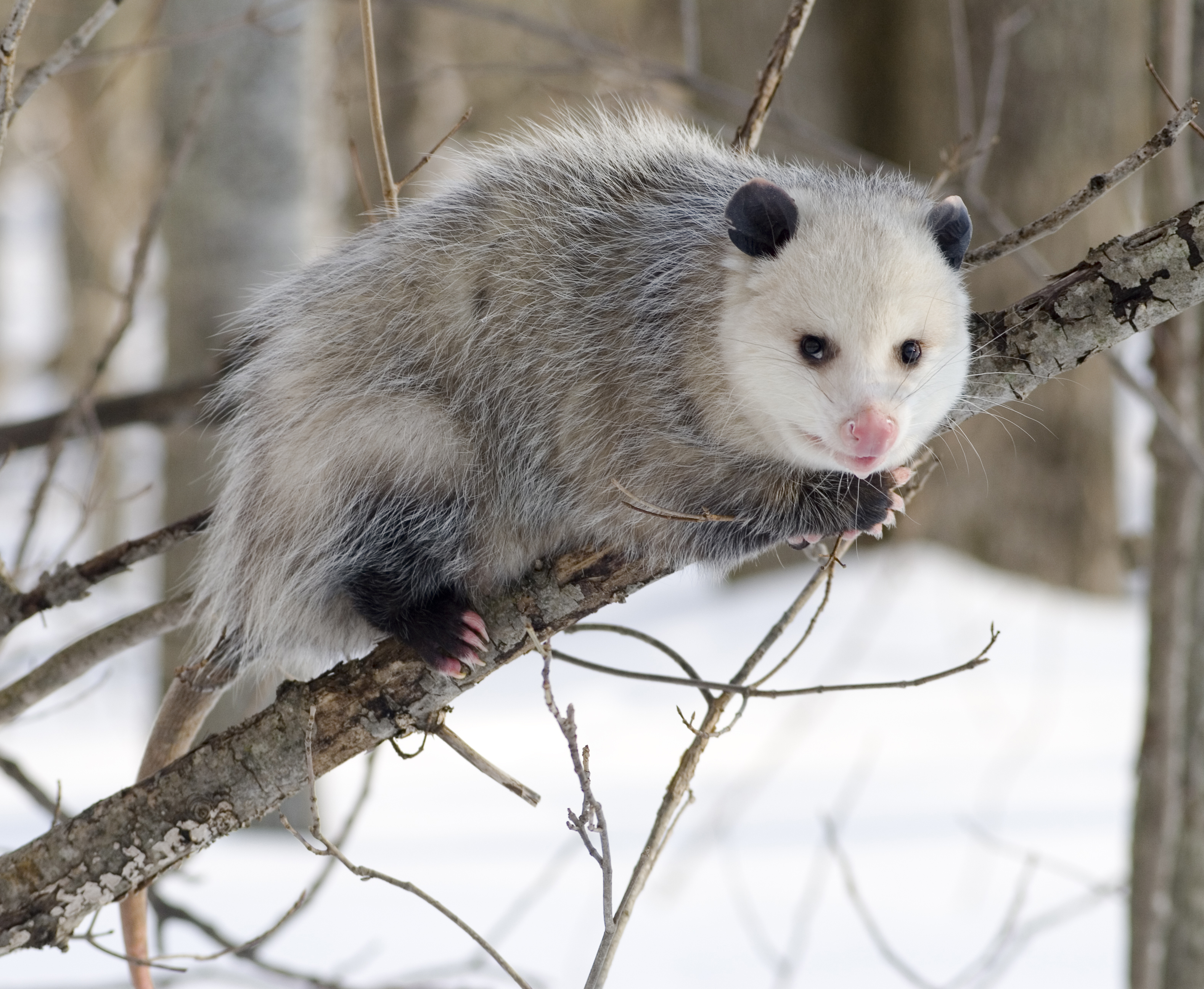 [Source]
You can learn more about these cool critters here, via the Smithsonian National Museum of Natural History.
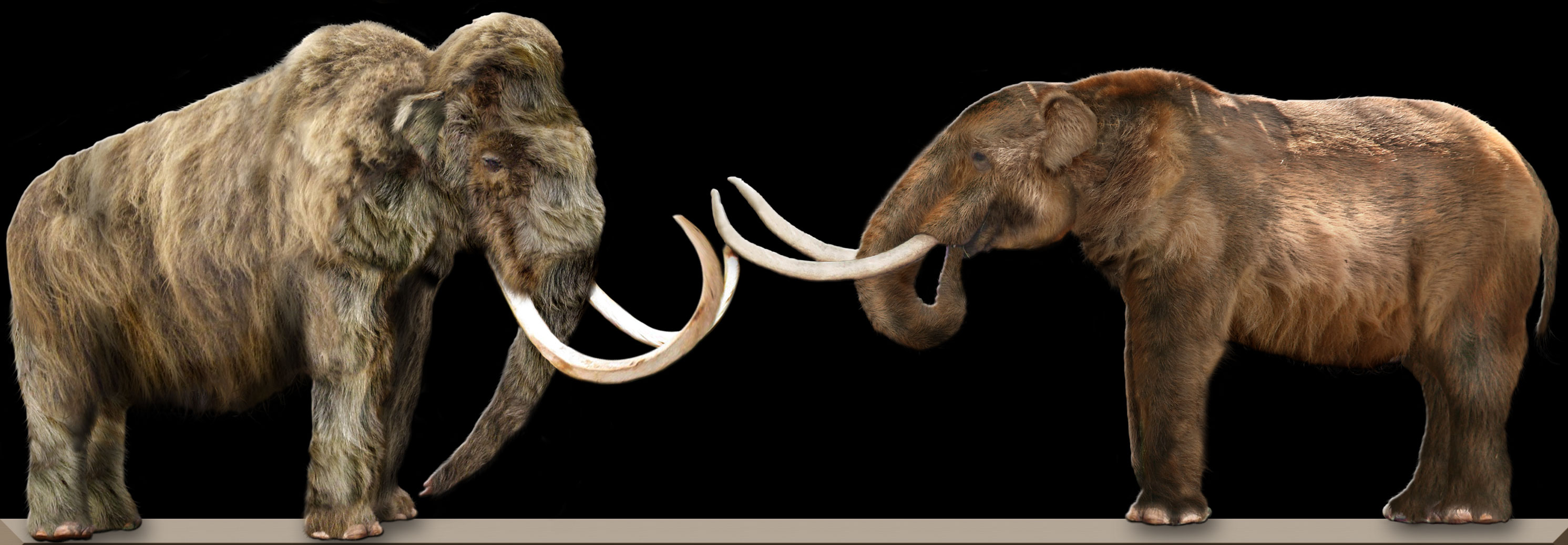
Monday Mammmal #11: Mastodon or Mammoth?
So which one's which, and what's the difference? Who lived where, and when did they live there?

You can learn more about mastodons and mammoths from the The Field Museum in Chicago, jump ahead to their page on how to tell the difference between the two (or here from the Smithsonian), read more about Mastodons here, more about Mammoths here and more about the group as a whole here and here.
You can learn more about mastodons and mammoths from the The Field Museum in Chicago, jump ahead to their page on how to tell the difference between the two (or here from the Smithsonian), read more about Mastodons here, more about Mammoths here and more about the group as a whole here and here.
Monday Mammal #10: Yagán “dog”

How about the (now extinct) Yagán dog - a domesticated South American fox (Pseudalopex culpaeus) that once lived among the Yagán people on the islands off the southern coast of South America.
I knew you'd agree.
Monday Mammal #9: Marsh Rice Rat
Many of this week's Monday Mammal, the Marsh Rice Rat (Oryzomys palustris), have likely perished recently as oil from the spill off of the Louisiana coastline has been recently been penetrating the coastal salt marshes. Fortunately, these little rodents aren't limited to these coastal marshes (unlike some species), and should (as a species, at least) persist beyond the recent disaster.

This rather broad ranging American native was first described in 1837 from a specimen taken in the north of their range in Salem Co. New Jersey. They are semi-aquatic, mostly nocturnal omnivores and are found primarily in coastal (salt water) and interior (fresh water) marshes. Like many (most?) other species, their distribution hasn't always been restricted to their current range. Despite being endemic to the south eastern U.S. their ancestors likely trace back to central and South America.
These rats belong to the subfamily Sigmodontinae, the South American rats and mice. While there is one other species of Oryzomys that makes it up into North America -- the Coues's Rice Rat (O. couesi) which occurs in southern Texas -- the other species in the genus Oryzomys all appear to occur further south.
Oh, and here's one of those random facts you just don't find in species accounts any more -- just in case you were wondering how different these rats are from their domestic cousins. Unlike domestic rats, Marsh Rice Rats have 27 pairs of autosomal chromosomes plus two sex chromosomes for a grand total of 56 chromosomes...
 [Source]
Hmm... this could make for a nice little pop quiz! Do you know how many chromosomes do we humans have?

Figure 1: "Oryzomys palustris - lower image is silvery subspecies O. p. argentatus of Florida Keys
Credit: painting by Ron Klinger from Kays and Wilson's Mammals of North America,
© Princeton University Press (2002)" [Source]
© Princeton University Press (2002)" [Source]
This rather broad ranging American native was first described in 1837 from a specimen taken in the north of their range in Salem Co. New Jersey. They are semi-aquatic, mostly nocturnal omnivores and are found primarily in coastal (salt water) and interior (fresh water) marshes. Like many (most?) other species, their distribution hasn't always been restricted to their current range. Despite being endemic to the south eastern U.S. their ancestors likely trace back to central and South America.
These rats belong to the subfamily Sigmodontinae, the South American rats and mice. While there is one other species of Oryzomys that makes it up into North America -- the Coues's Rice Rat (O. couesi) which occurs in southern Texas -- the other species in the genus Oryzomys all appear to occur further south.
Oh, and here's one of those random facts you just don't find in species accounts any more -- just in case you were wondering how different these rats are from their domestic cousins. Unlike domestic rats, Marsh Rice Rats have 27 pairs of autosomal chromosomes plus two sex chromosomes for a grand total of 56 chromosomes...

Hmm... this could make for a nice little pop quiz! Do you know how many chromosomes do we humans have?
Monday Mammal #8: Bill Nye the Science Guy?
Tuesday, June 8, 2010 at 1:17 AM

Labels: communicating science, entertainment, ethics, monday mammals, noteworthy people
Labels: communicating science, entertainment, ethics, monday mammals, noteworthy people

Video of his acceptance speech are up over at Hemant's Blog.
Monday Mammal #7: Big Kitty, Little Kitty
No natural history lesson today, just pure cuteness ...
 ... although, I do wonder if that bundle of cuteness didn't later become a snack.

Monday Mammal #6: The Gorilla
Monday, May 24, 2010 at 7:57 PM
Labels: being human, education, evolution, mammals, monday mammals, primates
Labels: being human, education, evolution, mammals, monday mammals, primates
Since gorillas seem to be popular lately, (see my recent post, this one from Laelaps and here in the news) I had little choice but to feature them as this week's Monday Mammal. Below, I'll first introduce the different gorilla species (yes, there are more than one!) then cover where they fall in the list of our closest primate relatives.


Gorillas are comprised of two species

Figure 1. Adult male gorilla, Denver Zoo, 2009

Figure 2. Hand of a female gorilla, napping at the Denver Zoo.
While I doubt gorillas have ever wished they had our hairless,
fragile bodies I'm have to be suffering with major thumb envy!
While I doubt gorillas have ever wished they had our hairless,
fragile bodies I'm have to be suffering with major thumb envy!
Gorillas are comprised of two species
Monday Mammal #5: The Venomous, Egg-laying Platypus
Monday, May 17, 2010 at 5:59 AM
Labels: education, evolution, intelligent design (creationism), mammals, monday mammals
Labels: education, evolution, intelligent design (creationism), mammals, monday mammals
This week's Monday Mammal, the Platypus (Ornithorhynchus anatinus), comes from the fringes of the group. These awesome little aquatic oddities serve as a wonderful reminder of what it really means to be a mammal, and of our own shared evolutionary history with other mammals and even other vertebrates like the reptilians, amphibians, and fishes. I mean seriously, how many other mammals can you name that have a bill, lay eggs, or are venomous!?

The class Mammalia is typically divided into two subclasses: the live-bearing Theria comprised of the vast majority of mammal species, and the subclass Prototheria comprised of the egg-laying Monotremes. Order Monotremata contains only two families: Ornithorhynchidae which includes only one living species (the platypus); and Tachyglosidae, which includes the three living echidna species.
Beyond their bird-like bills (which are lined with electroreceptors to aid foraging), platypus are venomous and do lay eggs, but technically you'll never see a platypus that is both egg-laying and venomous. The reason? Well, obviously only the females lay eggs, but it turns out only males possess venom glands and spurs on their hind legs (young females also have spurs, but no venom glands).
Like the panda's thumb (this one, not this one), the venomous spur is not a modified toe, but is anchored to a modified ankle bone. The spur is visible in this photo (Fig 2) and in this skeletal specimen (Fig 3) from the Melbourne Museum.


Finally, it's hard to talk about all the curious details of the platypus without touching upon the problems these organisms have historically posed for creationists. For example, see this entry at SkeptiWiki and this slightly longer article at TalkOrigins.org.

Figure 1: A Platypus, photographed in Eungella National Park, Queensland, Australia. [Source]
The class Mammalia is typically divided into two subclasses: the live-bearing Theria comprised of the vast majority of mammal species, and the subclass Prototheria comprised of the egg-laying Monotremes. Order Monotremata contains only two families: Ornithorhynchidae which includes only one living species (the platypus); and Tachyglosidae, which includes the three living echidna species.
Beyond their bird-like bills (which are lined with electroreceptors to aid foraging), platypus are venomous and do lay eggs, but technically you'll never see a platypus that is both egg-laying and venomous. The reason? Well, obviously only the females lay eggs, but it turns out only males possess venom glands and spurs on their hind legs (young females also have spurs, but no venom glands).
Like the panda's thumb (this one, not this one), the venomous spur is not a modified toe, but is anchored to a modified ankle bone. The spur is visible in this photo (Fig 2) and in this skeletal specimen (Fig 3) from the Melbourne Museum.
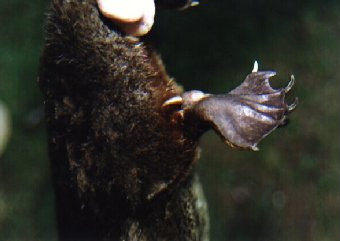
Figure 2: Hind leg, showing the spur. [Source]

Figure 3: Platypus skeleton. Note the number of hind toes and the venomous spur. [Source]
Finally, it's hard to talk about all the curious details of the platypus without touching upon the problems these organisms have historically posed for creationists. For example, see this entry at SkeptiWiki and this slightly longer article at TalkOrigins.org.
More Coatis!
I just came across this video clip on Coatis from the BBC series, Life[Amzn], and having recently featured them on this blog I just had to share. Can you identify which species appear in the documentary? Also, check out the coat color variation on those youngsters!
Monday Mammal #4: Coati
While most folks in North American are familiar with the Common Raccoon (Procyon lotor), few ever get to know their cousins the coatis. The name coati refers to a number of species in two genera: Nasua (coatis; 3 species) and Nasuella (mountain coatis; 1+ species). They are members of the Racoon family Procyonidae comprised by the Raccoons (3 species), Ringtail & Cacomistle, Olingos, and the Kinkajou. Like all members of this family, the coatis are native only to the Americas.
In the U.S., you could possibly find the northern most coati (Nasua) species -- the White-Nosed Coati (Nasua narica) -- which occurs from south eastern Arizona down to northern South America. The other two species occur on the island of Cozumel and in South America, respectively. The mountain coatis (Nasuella) occur in northern South America.
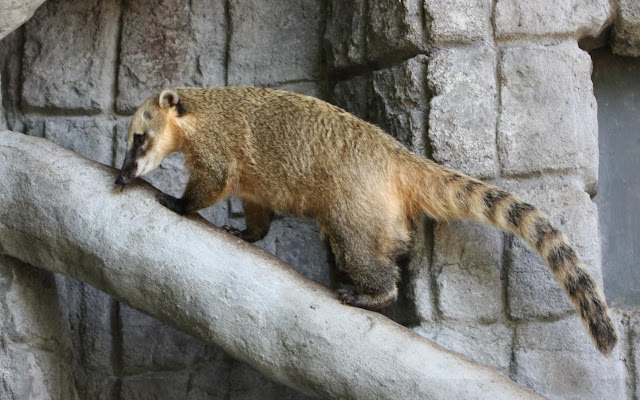
Here's a South American Coati (Nasua nasua) photographed at the Denver Zoo when I last visited there in July, 2009. This widespread omnivorous species includes over a dozen subspecies.
For more info and pictures of Procyonids, visit the University of Michigan's Animal Diversity Web: Family Procyonidae.
In the U.S., you could possibly find the northern most coati (Nasua) species -- the White-Nosed Coati (Nasua narica) -- which occurs from south eastern Arizona down to northern South America. The other two species occur on the island of Cozumel and in South America, respectively. The mountain coatis (Nasuella) occur in northern South America.
Here's a South American Coati (Nasua nasua) photographed at the Denver Zoo when I last visited there in July, 2009. This widespread omnivorous species includes over a dozen subspecies.

For more info and pictures of Procyonids, visit the University of Michigan's Animal Diversity Web: Family Procyonidae.
Monday Mammal #3: West Indian Manatee
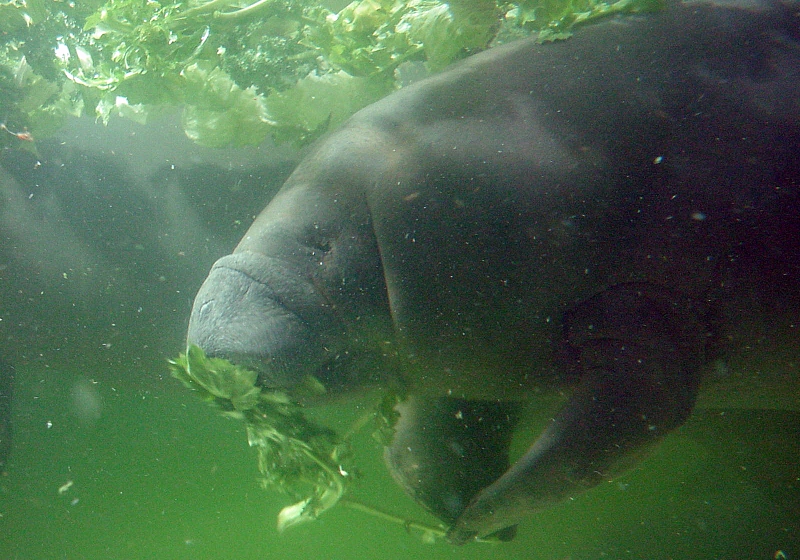
To showcase some of the wildlife impacted by gulf coast oil spill (see this post), this week's Monday Mammal is one that will likely be affected by the spill: The West Indian Manatee (Trichechus manatus).

The West Indian Manatee is one of 3 living manatee species, and one of 4 living species in the mammalian order Sirenia, which also includes the Dugong (Dugong dugon). These aquatic herbivores are thought to be most closely related to the elephant and hyrax, having evolved from land mammals a little over 60 million years ago.

These large animals (known to some as "sea cows") need to eat a huge quantity of aquatic vegetation, and it appears the oil spill could harm them by damaging the seagrass beds they rely on, in addition to whatever harmful effects might occur by ingesting or becoming covered in the oil.

To make matters worse, the late cold snap in the south eastern U.S. this winter has already taken a toll on the population. According to the Save the Manatee Club of Florida:

An adult West Indian Manatee with calf [Source]
The West Indian Manatee is one of 3 living manatee species, and one of 4 living species in the mammalian order Sirenia, which also includes the Dugong (Dugong dugon). These aquatic herbivores are thought to be most closely related to the elephant and hyrax, having evolved from land mammals a little over 60 million years ago.

Signs of their terrestrial ancestry include the toenails still present on their front flippers. [Source]
These large animals (known to some as "sea cows") need to eat a huge quantity of aquatic vegetation, and it appears the oil spill could harm them by damaging the seagrass beds they rely on, in addition to whatever harmful effects might occur by ingesting or becoming covered in the oil.
To make matters worse, the late cold snap in the south eastern U.S. this winter has already taken a toll on the population. According to the Save the Manatee Club of Florida:
[The BP spill] is especially troubling since it comes on the heels of the worst manatee winter die-off ever experienced, with over 500 total manatees dead already this year.You can read more about Manatees and Dugongs on the Sirenian International website and from the Save the Manatee Club. You can see more images of T. manatus from the wikimedia commons.
Monday Mammal #2: African Wild Dog
I've been busy the past few days, so this post is brief. To kick off the week, I considered offering up a familiar mammal, something like the domestic dog...

...but instead decided to go with something slightly more exotic. So instead, here's Lycaon pictus (aka the African wild dog, African painted dog, cape hunting dog, etc.) Below are a couple of photos taken at the Denver Zoo in late summer, 2009. You can read more about African Wild Dogs here, here, here or by following the links listed here.


Figure 1: Not an African Wild Dog (way too lazy).
...but instead decided to go with something slightly more exotic. So instead, here's Lycaon pictus (aka the African wild dog, African painted dog, cape hunting dog, etc.) Below are a couple of photos taken at the Denver Zoo in late summer, 2009. You can read more about African Wild Dogs here, here, here or by following the links listed here.


Monday Mammal #1: Pronghorn
I have a soft spot for cold blooded creatures, but that isn't to say I'm indifferent to those hot blooded, fur covered mammals. So what better use of all those mammal photos filling up my hard drive than yet another weekly series?
Yeah, same here - I couldn't think of anything better to do with them either - so weekly series it is! With that, I bring you the first Monday Mammal from my home state of Colorado: the Pronghorn (Antilocapra americana).

Quick story: Back when I was an undergraduate, I was lucky enough to help state wildlife officials in the capture and transport of some pronghorn from an area where they were in overabundance to an area looking to bolster their numbers.

Catching them went something like this...
If you'd like to know more about these unique critters, check out the Pronghorn page on the University of Michigan's Animal Diversity Web.
Update: For more, check out this fantastic post on "speedgoats" by Darren Naish over at Tetrapod Zoology.
(...brief pause to think about that question...)
Yeah, same here - I couldn't think of anything better to do with them either - so weekly series it is! With that, I bring you the first Monday Mammal from my home state of Colorado: the Pronghorn (Antilocapra americana).

Figure 1: A small herd of pronghorn around sunset in eastern Colorado in January, 2010.
This was shortly after Dr. Wife and I got hitched, and were headed to New Mexico for the
honeymoon. This group is feeding on walking stick cholla cactus (Cylindropuntia imbricata).
Despite being ruminant artiodactyls and bearing a close resemblance to true antelope (family Bovidae, along side cows and sheep), pronghorn are the only extant species in the family Antilocapridae and are apparently more closely related to giraffes and the okapi than anything else alive today. There are currently five recognized subspecies: the nominate American (A. a. americana), Oregon (A. a. oregona), Mexican (A. a. mexicana), peninsula (A. a. peninsularis), and Sonoran (A. a. sonoriensis).This was shortly after Dr. Wife and I got hitched, and were headed to New Mexico for the
honeymoon. This group is feeding on walking stick cholla cactus (Cylindropuntia imbricata).
Quick story: Back when I was an undergraduate, I was lucky enough to help state wildlife officials in the capture and transport of some pronghorn from an area where they were in overabundance to an area looking to bolster their numbers.

Figure 2: Dropping the net in 3... 2... 1...
Catching them went something like this...
- Herd them into a large V-shaped section of fence with a helicopter.
- Drive across the prairie in the bed of one of at least 5 trucks full of people.
- Form a line across the top of the V, and drive the herd into a large net (see the second photo above).
- Drop the net.
- Sprint like mad towards the trap to hold each individual down so they didn't hurt themselves or one another.
- Hobble and blindfold them to keep them calm and manageable.
- Move them into the transport trailors for relocation.
If you'd like to know more about these unique critters, check out the Pronghorn page on the University of Michigan's Animal Diversity Web.
Update: For more, check out this fantastic post on "speedgoats" by Darren Naish over at Tetrapod Zoology.
Subscribe to:
Posts (Atom)


