Showing posts with label noteworthy people. Show all posts

Talk on The Math, Physics of Drag Racing

Friday, October 29, 2010 at 5:00 PM Bookmark and Share
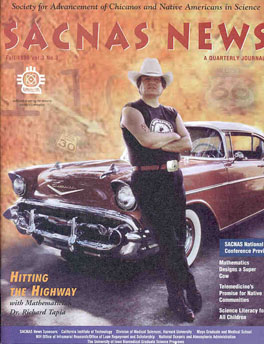
Thursday (4 Nov) there is a public lecture at COSI in Columbus you don't want to miss.  The talk will be given by Dr. Richard A. Tapia -- a big name in applied mathematics, an entertaining speaker, and long-time "champion of under-represented minorities in the sciences."

Tapia has received numerous professional and community service honors and awards including the annual Blackwell-Tapia Conference being named in his honor (his reason for visiting Columbus) and being inducted into the Texas Science Hall of Fame (yes, such a thing really does exist!).

Here are the details of his talk from the event flier (PDF):

Math at Top Speed: Exploring and Breaking Myths in the Drag Racing Folklore

November 4, 2010; 7:00pm @ COSI (doors open @ 6:00pm) Admission is free

For most of his life, Richard Tapia has been involved in some aspect of drag racing. He has witnessed the birth and growth of many myths concerning dragster speed and acceleration. Some of these myths will be explained and validated in this talk, while others will be destroyed. For example, Dr. Tapia will explain why dragster acceleration can be greater than the acceleration due to gravity, an age-old inconsistency, and he will present his Fundamental Theorem of Drag Racing. Part of this talk will be a historical account of the development of drag racing and several lively videos will accompany this discussion.

Speaker: Richard Tapia
University Professor Maxfield-Oshman Professor in Engineering, Department of Computational and Applied Mathematics (CAAM), Rice University

More about Dr. Tapia can be found here, here, and here.  More on the Blackwell-Tapia Conference can be found by clicking the "Blackwell-Tapia" link on this website.

Intelligent Design: Creationism's Trojan Horse

Monday, September 20, 2010 at 4:51 PM Bookmark and Share
A nice look at the history of the ID movement in the talk below, by NCSE board member Dr. Barbara Forrest (see below to jump around the video by topic highlights). You can read more about her book "Creationism's Trojan Horse" in this review at Panda's Thumb, or in the links given below.


A few bookmarks for those of you who'd like to jump around or don't have time to watch the whole thing:
  1. Dembski's juvenile attempt to anonymously thumb his nose at Judge Jones and others @ 1:20
  2. Talk begins @ 4:14
  3. Trojan Horse defined/discussed @ 5:30
  4. Intelligent Design as a Trojan Horse @ 6:00
  5. Dover Trial details begin around 7:50 
  6. Who's Who of the Discovery Institute: Center for the Renewal of Science & Culture @ 9:49
  7. Their infamous Wedge Strategy (and Wedge Document) @ 11:45
  8. Trial details begin around 13:30
  9. More from Dembski starting @ 14:00 (followed by more shenanigans from the Disco'Tute)
  10. Expert witnesses on the side of science (plaintiffs) @ 17:50
  11. Summary of lessons learned from the trial are in a nice book (see resource links below) @ 18:28
  12. Plaintiff's attorneys @ 18:43
  13. Expert witnesses on the side of intelligent design creationism (defendants) including those  who backed out @18:55
  14. Dr. Forrest describes her role in the trial @ 20:50 (followed by a nice summary of "ID = christian creationism")
  15. The evolution of the creationist-turned-ID text, Of Pandas and People @ 29:45
  16. The origin of that accidental term, cdesign proponentsists @ 33:00
  17. Cost of the Dover trial (including Dembski's $20K "for not showing up") @ 35:45
  18. 1982 source of "Complex specified information"; 1982 precursor to "Irreducible Complexity" @ 37:30
  19. Behe continues on after the trial, his book, etc. @ 39:00
  20. Key terms/phrases used by ID proponents - things to look out for @ 39:25
  21. The new replacement creationist text? Explore Evolution @ 41:00
  22. Nice book list of additional reading on the Creationism vs. Evolution conflict @ 42:34
  23. Did you know Dembski helped A. Coulter write ID chapters in 'Godless'? @ 44:06
  24. Talk ends @ 44:40, Q&A begins.
See anything else worth noting? Please take note of the time, and leave a comment below.  If it doesn't slip my mind, I'll try and include comments above on what's in the Q&A when I get a chance.

Resources

  1. Scott, E. C., Branch, G. 2006. Not in our classroom: Why Intelligent Design is Wrong for Our Schools.  http://ncse.com/nioc (purchase here).
  2. Trial Documents from Kitzmiller vs. Dover available here on the NCSE website.
  3. Dr. Forrest's Creationism's Trojan Horse website: http://www.creationismstrojanhorse.com/ Both book info and info/resources from the Dover trial.

How to disprove evolution

Thursday, July 29, 2010 at 12:30 AM Bookmark and Share
... according to a Texan.


Oh, right, I should of course mention that this particular Texan is a wickedly sharp scientist and creator of some hugely popular YouTube videos on creationism, evolution and science education. Nothing wrong with knowing how to disprove a scientific theory - after all, that's how science works!

Now head on over and check out AronRa's youtube channel for more of his great videos.

Elements of Math, by Steven Strogatz

Thursday, July 8, 2010 at 12:19 AM Bookmark and Share
Courtesy of the editors at the New York Times Opinionator blog:
Professor Strogatz’s 15-part series on mathematics, which ran from late January through early May, is available on the “Steven Strogatz on the Elements of Math” page.
Go check it out! Strogatz is an excellent speaker and writer, and any minute spent reading his writing is a minute very well spent.

Craig Venter on the "synthetic cell"

Saturday, June 12, 2010 at 3:05 AM Bookmark and Share
I received an email a few weeks back from a reader suggesting I do a post or two on Craig Venter's recent accomplishment taking a bacterial cell and swapping in a fully synthetic genome, essentially making a new bacterial species.  It's a great suggestion, as I think what Venter and his colleagues have done qualifies as some smokin' hot, kick-ass science.  Unfortunately, I've not had much time to read up on the details, as I've been a bit busy with a conference and some pressing thesis work I need to get done (like yesterday).

As it happens, I just now stumbled across an opportunity to (at least briefly) touch on the subject. Check out  this gem of an interview with Craig Venter.


If you'd first like a sampler of what's in the video, below are a few selections that caught my attention (though I strongly recommend you watch it in it's entirety at least twice... maybe more!).

When I was first asked whether I found all this amazing, scary or both, I went with both, leaning more towards amazing than scary.  Now that I've looked into it further, I'm squarely at amazing and so far from scary it's almost scary! Venter and his colleagues seem to have put a great deal of effort into subjecting their research plans to serious ethical considerations, as mentioned briefly below, making sure their synthetic cell was too crippled and dependent on specialized media to thrive outside of the lab. Not at all surprising, but worth mentioning.

So what's the big deal here? I mean, yes it sounds cool - but what's the point? How will this impact my daily life in the coming years?  To answer that question we first need to be clear about what exactly they've done: very briefly, they've slapped together a genome sequence in a computer (yup, just a string of ...AGATCCACTAC... only it received a bit more forethought than my sequence) using the genome of a real organism as a starting point.  Then, they made the DNA using some advanced biochemistry and custom instrumentation (think of the expensive instruments used to read DNA sequences, but working in reverse). Next, they took that genome and used it to replace the genome of a bacterial cell. After that, they let their little unicellular Frankenstein go about doing it's own thing, happily reproducing itself in a lab somewhere.

While most of the media focus is on little Frankenstein, the real gem here are the techniques and technology that made it all possible.  As far as making a new cell goes, they didn't quite go there. They tweaked the genome a bit on the computer, made the genome (which really is an impressive accomplishment) and handed it off to an existing cell.  To use Venter's computer analogy, what they did was something like the cellular version of reformatting a computer running Debian linux, and replacing the operating system with a copy of Damn Small Linux.  Not a big change to say, Windows, and definitely not rebuilding a new computer from scratch.

Still, there are many reasons why their accomplishment is darn cool.  First, here's Venter with the big picture....
Interviewer: What do you ultimately hope to do with a method like this?
Venter: Well, this is an important step we think both scientifically and philosophically. It's certainly changed my views of definitions of life, and how life works. It's pretty stunning when you just replace the DNA software in a cell and the cell instantly starts reading that new software -- starts making a whole different set of proteins -- and within a short while all the characteristics of the first species disappear and a new species emerges from this software that controls that cell going forward. When we look at lifeforms we see them as sort of fixed entities. But this shows in fact how dynamic they are, that they change from second to second. And, that life is basically a result of an information process -- a software process -- our genetic code is our software. Our cells are dynamically, constantly reading that genetic code making new proteins, the proteins make the other cellular components, and that's what we see.

From a more practical perspective, our own success as a species has been in large part due to our ability to mix and match the DNA of different organisms for our benefit.  We've advanced from simple selective breeding of livestock and crops, interspecific hybridization, and basic artificial selection up through the relatively recent discovery of DNA and the ability to alter genetic material directly.  Venter et al's new techniques are another big step in that same direction.  This may have many implications, such as this example mentioned by Venter:
Perhaps the most important, immediate application is ... we're already working at the Venter Institute and working with Novartis to try and make new vaccines very quickly. We think we can shorten the process by 99% for making the flu vaccine each year by using these new synthetic techniques.
For flu and other pathogens with relatively high rates of evolution, and for some newly emerging infectious disease, we're limited in how quickly we can mass produce vaccines. This is perhaps common knowledge following last years swine flu pandemic, but increasing our response time to vaccinate against emerging infectious disease by an order of magnitude or two could literally save millions of human lives.

Finally, they've also done some pretty cool things that have little to do with the frontiers of science and technology.  Nothing wrong with having a little fun while you work, right?
We've developed a new code for writing english language, other languages, with punctuation and numbers into the genetic code. In the first watermark [in the new genome] we actually have this code that needs to be decoded for people to read the rest. We even have a website built into the genetic code that if people solve it they can let us know that they've been able to read it.

Monday Mammal #8: Bill Nye the Science Guy?

Tuesday, June 8, 2010 at 1:17 AM Bookmark and Share
Oh, come on - he won the 2010 Humanist of the Year award!  I say that totally earns him some spotlight time as a noteworthy mammal (...plus I've been a bit busy lately).

Video of his acceptance speech are up over at Hemant's Blog.

Neil DeGrasse Tyson on the value of scientific literacy

Sunday, June 6, 2010 at 1:14 PM Bookmark and Share
I've often heard students question the day-to-day value of science: "Yeah, but how is knowing <insert scientific claim> going to impact my life if I'm not a scientist?" In my experience, these individuals almost always confuse a particular scientific claim with the scientific process that lead to acceptance of that claim.

Often times they're right - some scientific facts are simply useless for most people - but any decent response to their question should always bring them back to science as a process, not a fact. 
"Science literacy empowers you to know when someone else is just basically full of it. Because you understand... how the world works and what the limitations are, then you can judge whether someone is trying to exploit your scientific ignorance."
In the clip below, American astrophysicist (and kick-ass public speaker) Neil DeGrasse Tyson explains.

BCA Drops Libel Case Against Singh!!

UpdateAccording to Ben Goldacre, Singh may go after the BCA to recover his legal costs. You can read more on the case and the remaining need for British libel reform in Goldacre's article in the Guardian.

The British Chiropractic Association (BCA) has dropped is libel case against science journalist Simon Sigh following the recent ruling that Singh could appeal an earlier verdict against him.  Details can be found on the BCA's website here (PDF) via the Sense About Science site here or at the Libel Reform Campaign website here.

BCA V SIMON SINGH - PRESS STATEMENT – 15th APRIL 2010

Having carefully considered its position in the light of the judgment of the Court of Appeal (1st April 2010), the British Chiropractic Association (BCA) has decided to discontinue its libel action against Simon Singh.
...
The BCA takes seriously its duty and responsibilities to members and to chiropractic patients. The BCA has considered seeking leave to take this matter to the Supreme Court and has been advised there are strong grounds for appeal against the Court of Appeal judgment. However, while it was right to bring this claim at the outset, the BCA now feels that the time is right for the matter to draw to a close.

Despite this big victory for Singh, it's only a non-loss for free speech.  Libel laws in the UK still need reform to protect free speech and promote open dialog -- and not just in the UK, but world-wide.

I would have preferred the outcome where Simon won his case on appeal, setting legal grounds for future libel cases against journalists. To learn more about libel law reform in the UK, visit the Sense About Science and The Libel Reform Campaign websites.

Small free speech victory: Singh wins right to appeal!

Friday, April 2, 2010 at 1:04 PM Bookmark and Share
For details, jump on over to this BBC article. While you're there, definitely watch the video and listen to what Singh has to say on the need to reform libel laws in the U.K.

I couldn't find a way to embed that video here, but here's a little more from him after the ruling...


To learn more about what you can do to help reform libel laws in the U.K., visit the Sense About Science and The Libel Reform Campaign websites.


Update:

More from the BBC...

Lawrence (Larry) Slobodkin (1928-2009)

Tuesday, September 22, 2009 at 3:02 PM Bookmark and Share
I just read in the New York Times that the influential ecologist Lawrence Slobodkin passed away on Friday.  You might take a few minutes and give his obituary a read.

One could learn a whole lot of ecology just by reading the many studies and publications that followed from some of his work - particularly the classic 1960 paper by Hairston, Smith and Slobodkin (a.k.a. the H.S.S. paper or the paper that gave us the "green world hypothesis").

The Ecological Society of America (ESA) awarded him their highest honor in 2005, the Eminent Ecologist Award.  They said of him...
Larry Slobodkin is one of the premier ecologists of our time. He has made lasting contributions to the theoretical and empirical development of ecology. Beyond this, however, many of us have been greatly influenced by the wonderfully original and insightful perspectives that flow from his unfettered mind.

References:

  1. Hairston N G, Smith F E & Slobodkin L B. Community structure, population control, and competition. American Naturalist 94:421-5, 1960. (PDF)
  2. More at the Wikipedia page...

Obama's critics on the speech to students

Tuesday, September 8, 2009 at 11:21 AM Bookmark and Share
With commentary on Obama's speech starting to pop up in various news sources, so to are the wacky statements made by some of the critics. For example, from this CNN piece:
"The president's speeches tend to be [about] what's wrong with the country and what can we do to fix it," said Bill Hogsett, a parent from Dallas, Texas.


"I believe this is the greatest country on Earth, and I try to teach that to my children. ... I don't want them hearing that there's a fundamental flaw with the country and the kids need to go forward to fix it."
Yes, that's right - apparently acknowledging problems and trying to fix them is very bad.  Even worse if you expect the next generation to deal with those problems! Oh, the horror!

So are these acknowledgments somehow unpatriotic? Would recognizing a "fundamental flaw" invalidate a belief that this "is the greatest country on Earth"?  Heck no. Our founding fathers recognized that no country - even this one - is not immune from having flaws.  That's why we have the ability to amend our constitution - so that those flaws can be corrected.

In any case, I hope you read Obama's speech - it's arguably the best speech made by a president specifically to students and will hopefully have some impact on the students that were fortunate enough to have heard it.

Where can you watch Obama's Speech to Students?

Monday, September 7, 2009 at 10:07 AM Bookmark and Share
Right here! The live presentation should be shown below on Tuesday September 8th, 12:00pm (EDT). [Edit: a copy of the speech has replaced the White House live feed.]

More information at the White House media resources page and blog.

Update: Is Obama going to politicize the speech?


Will he try and "indoctrinate" the youth of America? Will the speech be full of political advertising? Is this address really unprecedented? We have to just wait and see on the first two questions - but to help us judge his speech and answer them, we have some historical precedent to consider.

To establish this benchmark for Obama's speech tomorrow, lets take a look at Reagan's 1988 speech to students, and Bush senior's speech in 1991 and see how they did on keeping politics, policy and personal beliefs out of their speeches:


Reagan was relatively strong in pushing religion on the students, and was pretty sloppy with his history:

[Transcribed from above]... For America to gain greatest benefit from all the exciting new technologies that lie ahead, we will also need to reaffirm our traditional moral values, because these values are the foundation on which everything we do is built. So yes, I would encourage you to study the math and science that are the basis of the new techologies, but in a world of change you also need to pay attention to the moral and spiritual values that will stay with you unchanged throughout a long lifetime.


And again, I would say that the most important thing you can do is to ground yourself in the ideas and values of the American Revolution, and that is a vision that goes beyond economics and politics. It's also a moral vision, grounded in the reverence and faith of those who believed that with God's help, they could create a free and democratic nation. They designed a system of limited government that - in John Adam's words - was suited only to a religious people, such as ours. Our founding fathers were the descendants of the pilgrims. Men and women who came to America seeking freedom of worship, who prospered here and offered a prayer of thanksgiving - something we've continued to do each year...

Bush Sr. seems to have been a little bit less questionable in his speech, though it still was thick with his policy.

Seeing these two speeches, there is something to be said for keeping the president in check when he speaks in the classroom. How will Obama do? I myself hope to see Obama leave out culture, faith, and national policy (unlike Reagan and Bush) - and instead I hope he talks to (not at) the students about the personal and social importance of working hard to get a good education, providing them with some solid advice and encouragement to do their best to obtain that education.


Final Update

The text of the speech is available here.

How does U.S. healthcare compare with other countries?

Friday, August 28, 2009 at 12:24 PM Bookmark and Share
Many have already seen this nice article by T. R. Reid in the Washington Post, but it's such a worthwhile read I thought I'd give it some mention here.  The short answer to the question in the title above is summed up nicely near the end of the article:
In many ways, foreign health-care models are not really "foreign" to America, because our crazy-quilt health-care system uses elements of all of them. For Native Americans or veterans, we're Britain: The government provides health care, funding it through general taxes, and patients get no bills. For people who get insurance through their jobs, we're Germany: Premiums are split between workers and employers, and private insurance plans pay private doctors and hospitals. For people over 65, we're Canada: Everyone pays premiums for an insurance plan run by the government, and the public plan pays private doctors and hospitals according to a set fee schedule. And for the tens of millions without insurance coverage, we're Burundi or Burma: In the world's poor nations, sick people pay out of pocket for medical care; those who can't pay stay sick or die.

More details on the proposed U.S. healthcare system changes - and the many myths and outright lies about those those changes - at:

Obama calls upon the nation to hit the books!

Tuesday, February 24, 2009 at 10:22 PM Bookmark and Share
Tonight in President Obama's address to Congress, he asked fellow citizens to further their education - and he backed up his request with a promise of support. Why? To summarize using his own words, the reason education is a big economic issue is that "the countries that out-teach us today will out-compete us tomorrow."

The following is an excerpt from his address (full transcripts at CBS news). Video of the address is also likely to be readily available. For more details, visit www.whitehouse.gov and see the president's agenda on education.

The President:
In a global economy where the most valuable skill you can sell is your knowledge, a good education is no longer just a pathway to opportunity - it is a pre-requisite.

Right now, three-quarters of the fastest-growing occupations require more than a high school diploma. And yet, just over half of our citizens have that level of education. We have one of the highest high school dropout rates of any industrialized nation. And half of the students who begin college never finish.

This is a prescription for economic decline, because we know the countries that out-teach us today will out-compete us tomorrow. That is why it will be the goal of this administration to ensure that every child has access to a complete and competitive education - from the day they are born to the day they begin a career.

Already, we have made an historic investment in education through the economic recovery plan. We have dramatically expanded early childhood education and will continue to improve its quality, because we know that the most formative learning comes in those first years of life. We have made college affordable for nearly seven million more students. And we have provided the resources necessary to prevent painful cuts and teacher layoffs that would set back our children's progress.

But we know that our schools don’t just need more resources. They need more reform. That is why this budget creates new incentives for teacher performance; pathways for advancement, and rewards for success. We’ll invest in innovative programs that are already helping schools meet high standards and close achievement gaps. And we will expand our commitment to charter schools.

It is our responsibility as lawmakers and educators to make this system work. But it is the responsibility of every citizen to participate in it. And so tonight, I ask every American to commit to at least one year or more of higher education or career training. This can be community college or a four-year school; vocational training or an apprenticeship. But whatever the training may be, every American will need to get more than a high school diploma. And dropping out of high school is no longer an option. It’s not just quitting on yourself, it’s quitting on your country - and this country needs and values the talents of every American. That is why we will provide the support necessary for you to complete college and meet a new goal: by 2020, America will once again have the highest proportion of college graduates in the world.


While I could nitpick at some of the issues he brought up (the notion of reform as a guaranteed means of improvement, is the first that comes to mind) I'll keep this post short and leave it at that, for now.

Other links of possible interest:

Darwin Days @ Cornell: Dr. Massimo Pigliucci

Tuesday, February 10, 2009 at 9:40 PM Bookmark and Share
This week, many people across the globe are celebrating Charles Darwin's 200th birthday (this Thursday the 12th), and the 150th anniversary of the publication of the Origin of Species. Cornell University and the Museum of the Earth have put together a fantastic lineup of lectures and events and a website with all the details which can be found here.

This evening, and yesterday afternoon during the Ecology and Evolutionary Biology weekly seminar, I had the great pleasure of listening to Dr. Massimo Pigliucci. I won't go into great detail, but the bulk of his second talk "What's science got to do with it? When scientists talk nonsense about religion" was a gem to listen to, and touched on a many interesting issues central to the conflict between religion and science.

I would strongly encourage you to check out his website and blog, where you can find some of his writing, publications, lecture slides, and mention of some of his books on science, evolution, and philosophy.

Here is a short list of points that caught my attention during his talk, here written in my words and not his. These mostly related to evolution and creationism/intelligent design, but touch on aspects of general science as well:
  • When talking with someone (in his case, usually students) who is conflicted between their religious beliefs and learning about evolution, he gives these following words of advice: I won't ask you to believe it, I simply ask that you understand it.
  • Quoting Richard Feynman (the physicist) from The Meaning Of It All: Thoughts Of A Citizen-scientist, he reiterated that the root of much conflict between religion and science comes from the notion that (to use another Feynman quote) "Religion is a culture of faith; science is a culture of doubt. "
  • The conflict between evolutionary theory and creationism/intelligent design is not a scientific conflict, but a sociological and philosophical one. Science can only prove or disprove assertions about the natural world and is limited (if not unable) to prove or disprove assertions of a supernatural nature.
  • That said, when religions make claims about the natural world (e.g. the earth 10,000 years old) a scientific approach can be used to evaluate them.
  • Scientists would do well to learn about and apply the philosophy of science in their pursuits! Understanding the strengths and limitations of science can (of course) make for better science. I particularly enjoyed his commentary on statistics, which can be found on his website.
  • Waiting until high school or college to teach basic science and critical reasoning is a no-no! This should be taught from early on, just like we teach reading, writing and mathematics.
My time is up for now, but I hope you get a chance to check out some of Massimo's work as well as any of the "Darwin Day" events that might be going on in your neck of the woods. That's all for now! :)